
TL;DR:
- Most sales teams still practice superficial consultative techniques that leave revenue on the table despite knowing its effectiveness.
- Effective consultative selling relies on meaningful dialogue, structured techniques like SPIN, and multithreaded stakeholder engagement to accelerate sales and build confidence.
Most sales leaders I speak with already know that consultative selling works better than a pitch-led approach. Yet a surprising number of teams are still practising a watered-down version of it, asking a few discovery questions before launching straight into a product demo. That gap between knowing and doing is exactly where revenue gets left on the table. This article sets out the advanced frameworks, practical techniques, and UK-relevant nuances that genuinely move the needle, from SPIN Selling’s question architecture to orchestrating value across your entire commercial team for buyers who increasingly want less rep involvement, not more.
Table of Contents
- What makes consultative selling different?
- Core consultative selling techniques every team needs
- Discovery mastery: framework, edge cases and advanced questioning
- Consultative selling in a rep-free world: orchestrating multithreaded engagement
- Transformational results: measurable revenue, velocity and conversion gains
- Consultative selling: what most leaders miss (and what really works)
- Supercharge your team’s sales growth with expert guidance
- Frequently asked questions
Key Takeaways
| Point | Details |
|---|---|
| Consultative selling drives results | Teams using advanced consultative techniques see measurable gains in revenue and pipeline velocity. |
| Discovery quality over quantity | Effective questioning depends on using the right types of questions, not asking more indiscriminately. |
| Orchestration is essential | Aligning sales, marketing, and service ensures consultative value at every buyer touchpoint—even rep-free. |
| Flexibility beats rigid scripts | Top leaders personalise consultative techniques to each buyer and deal, always adapting in real time. |
What makes consultative selling different?
Let’s start by clearing up what consultative selling actually is, because there is a lot of noise around it. Gartner defines it as a style focused on uncovering, understanding, and responding to the customer’s underlying business need through meaningful dialogue, rather than a pitch-led approach. That definition matters because it immediately rules out three myths I hear regularly.
Myth one is that consultative selling just means asking more questions. It does not. You can ask twenty questions and still be completely transactional if none of them probe the buyer’s underlying business challenge or future risk.
Myth two is that consultative selling takes longer. Done well, it actually shortens cycles because you qualify out weak opportunities earlier and give buyers exactly the context they need to make a confident decision.
Myth three is that it only works in complex, high-value deals. Not true. Even inside sales teams handling mid-market accounts benefit significantly once they shift from feature-listing to need-uncovering.
“Consultative selling is a style focused on uncovering, understanding, and responding to the customer’s underlying business need through meaningful dialogue rather than a pitch-led approach.” Gartner
Here is what separates consultative from transactional selling in practical terms:
- Transactional sellers lead with product; consultative sellers lead with questions about business impact
- Transactional sellers present solutions early; consultative sellers confirm the problem is real and painful before presenting anything
- Transactional sellers rely on price to close; consultative sellers build so much value through diagnosis that price becomes secondary
- Transactional sellers treat every call the same; consultative sellers flex their approach based on the buyer’s maturity, urgency, and context
You can read more about why this shift pays off in the advantages of consultative selling for growing UK businesses. With the misconceptions set aside, let’s break down exactly how advanced consultative techniques are structured.
Core consultative selling techniques every team needs
Now that we understand the building blocks, let’s put them into practice, starting with where most deals succeed or fail: discovery.

Two frameworks sit at the heart of high-performance consultative sales teams. The first is Highspot’s five-part methodology, which gives reps a practical engine to run inside every conversation: ask thoughtful open-ended questions, understand each buyer’s individual needs, flex strategy in response, proactively guide buyers toward clarity, and build trust through qualifiers and genuine feedback loops.
The second is SPIN Selling. Developed by Neil Rackham and derived from analysis of 35,000 sales calls over twelve years, SPIN structures discovery around four question types: Situation, Problem, Implication, and Need-payoff. Each type has a distinct purpose.
- Situation questions establish context (current processes, team structure, tooling)
- Problem questions surface pain or friction the buyer is experiencing
- Implication questions expand the impact of that pain (“What does that cost you each quarter?”)
- Need-payoff questions invite the buyer to articulate the value of solving it (“If you could halve that cycle time, what would that free up for your team?”)
The sequence matters enormously. Most reps spend too long on Situation and skip straight to solutions. The real persuasion happens in Implication and Need-payoff, where the buyer convinces themselves. You can explore a consultative selling step by step approach to see how this plays out in practice.
| Transactional action | Consultative equivalent |
|---|---|
| Lead with product features | Open with a diagnostic question |
| Present early in the call | Confirm pain before presenting |
| One-size-fits-all pitch deck | Tailored agenda based on pre-call research |
| Price-led close | Value-led summary using buyer’s own words |
| Single contact engagement | Multithreaded stakeholder alignment |
Pro Tip: The moment you feel the urge to start presenting, pause and ask one more Implication question instead. Nine times out of ten, it unlocks information that changes what you would have said anyway.
Discovery mastery: framework, edge cases and advanced questioning
But modern buying is rarely a neat, rep-led process. What happens when buyers want less engagement, not more? That challenge starts right here in discovery.
SPIN’s core behavioural insight is that not all question types contribute equally. Discovery quality depends entirely on using the four types in the right proportion and sequence, not simply asking more questions. Over-indexing on Situation questions, which is the most common mistake, creates a feeling of interrogation rather than consultation. Buyers lose patience. Trust erodes before you have even reached the problem phase.
The fix is deliberate pacing. Limit yourself to two or three Situation questions per call, using pre-call research to eliminate the obvious ones. Move into Problem and Implication territory quickly. The sweet spot most experienced consultative sellers find is roughly 20% Situation, 30% Problem, 35% Implication, and 15% Need-payoff. That is not a rigid formula, but it gives you a calibration point when calls feel like they are drifting.
Here are the most common discovery pitfalls and how to address them:
- Over-preparing a script: Scripts create robotic delivery. Prepare an agenda and key question themes instead, then follow the buyer’s narrative.
- Ignoring emotional signals: UK B2B buyers are often understated in expressing frustration. Listen for phrases like “it’s a bit of a challenge” or “we manage around it.” Those are pain signals, not dismissals.
- Failing to confirm understanding: Paraphrase what you have heard before moving on. This demonstrates active listening and prevents misalignment later in the process.
- Rushing to the solution phase: Implication questions take time to land. Give the buyer space to sit with the scale of the problem before you introduce anything.
Pro Tip: UK buyers, particularly in sectors like financial services, professional services, and manufacturing, place high value on credibility established early in a conversation. Reference a relevant client outcome or industry context in your opening two minutes. It signals you have done your homework and shortens the trust-building phase considerably.
A well-structured discovery call, blending SPIN rigour with Highspot’s adaptive approach, is the single most impactful habit you can install across your team. Use our B2B sales checklist to ensure your team is covering every critical stage.
Consultative selling in a rep-free world: orchestrating multithreaded engagement
Gartner reports that 67% of B2B buyers now prefer a rep-free experience. That is a striking number, and it has significant implications for how UK sales leaders design their consultative approach.
It does not mean buyers want no help. It means they want to access information, compare options, and build confidence in their own way and on their own timeline. Your job as a sales leader is to ensure that consultative value exists across every touchpoint, not only during a live call with a rep.
Gartner’s commercial strategy guidance makes this explicit: revenue growth is linked to orchestrated, multithreaded engagement that aligns marketing, sales, and customer service around the buyer’s needs throughout the entire journey. That is a significant shift from the traditional model where sales owned the relationship and marketing filled the top of the funnel.
In practice, orchestrating consultative value across your commercial team looks like this:
- Marketing creates diagnostic content that mirrors discovery questions (buyer guides, maturity assessments, ROI calculators) so self-directed buyers can qualify themselves
- Sales reps are trained to pick up existing context from marketing interactions rather than starting each conversation from zero
- Customer success and account management teams are equipped to ask Implication and Need-payoff questions in renewal conversations, not just check-in calls
- Sales enablement materials reflect genuine buyer problems, not product features, so buyers encounter consistent consultative messaging regardless of the channel
Multithreaded engagement specifically means engaging multiple stakeholders within the same account simultaneously. In UK mid-market and enterprise deals, buying decisions rarely rest with a single person. Finance, operations, IT, and the commercial director often all have a stake. A rep who builds rapport with only one contact is one restructure or holiday away from losing the deal entirely.
Teams that get this right consistently deliver sales consultancy for UK growth at scale. And the numbers confirm it. Last, let’s examine what consultative selling can deliver quantitatively when embedded well in a UK sales organisation.
Transformational results: measurable revenue, velocity and conversion gains
With these numbers in hand, let’s reflect on what disciplined consultative selling actually produces in practice.
A case study from an industrial manufacturer that adopted a more rigorous, consultative-aligned sales process reported results that most sales leaders would consider genuinely exceptional: revenue up 20%, sales cycle shortened from 52 days to 28 days (a 46% reduction), conversion rate up 18%, and pipeline velocity up 48%.
“A more disciplined, consultative sales process delivered +20% revenue, a 46% shorter sales cycle, +18% conversion, and +48% pipeline velocity.” Revenue Velocity Lab case study
These are not outliers. They are the kinds of outcomes I see consistently when teams commit to the full picture, not just the discovery call, but the qualification discipline, the stakeholder mapping, the aligned content, and the feedback loops.
| Metric | Before consultative approach | After consultative approach |
|---|---|---|
| Revenue growth | Baseline | +20% |
| Sales cycle | 52 days | 28 days (46% faster) |
| Conversion rate | Baseline | +18% |
| Pipeline velocity | Baseline | +48% |
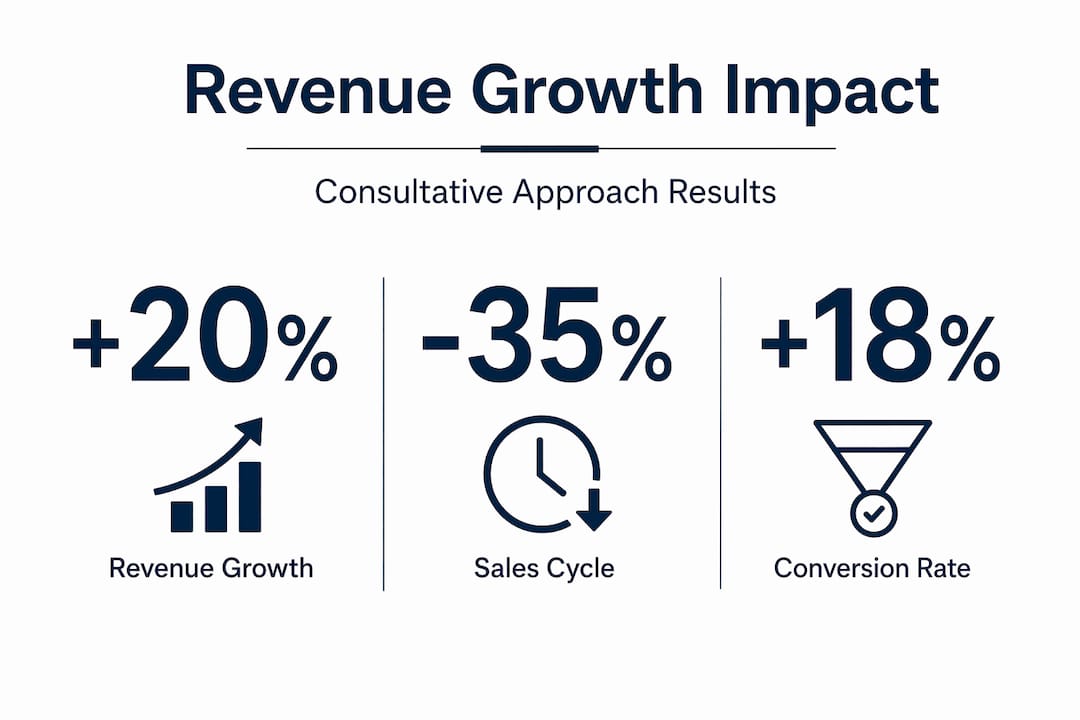
The key takeaways for sales leaders scaling revenue with consultative methods are straightforward. First, the gains are not from a single technique but from building the whole system. Second, shorter sales cycles come from better qualification early, not from rushing buyers later. Third, conversion improvements happen because buyers who go through a genuine consultative process arrive at the decision with far greater confidence.
If shortening sales cycles is a priority for your team right now, that discipline in the discovery and qualification phase is where the leverage is.
Consultative selling: what most leaders miss (and what really works)
Here is the honest observation I come back to repeatedly when working with UK sales leaders: most teams learn the framework, then quietly revert to what is familiar under pressure.
SPIN Selling gets introduced in a training session. Reps practise it. Managers nod approvingly. Then a quarter end arrives, targets are looming, and suddenly every call becomes a pitch again. The framework was never embedded; it was just performed.
Highspot’s guidance on execution is explicit about this: truly consultative sellers abandon the script and adapt in real time. That is not a licence to be unprepared. It is a reminder that the goal of all your preparation is to free your attention so you can actually listen to what the buyer is telling you, rather than mentally rushing toward your next prepared question.
The leaders who build genuinely consultative teams do three things differently:
- They install regular coaching loops, not just annual training events. Weekly deal reviews that focus on the quality of the questions asked, not just the pipeline stage, are far more powerful than any one-day workshop.
- They align marketing and service into the consultative motion rather than treating it as a sales-only discipline. The buyer’s experience of your company should feel consultative from first content touchpoint to post-sale review.
- They measure leading indicators alongside revenue, tracking things like average number of stakeholders engaged per deal, question-to-pitch ratio on discovery calls, and how often Implication questions feature in call recordings.
The uncomfortable truth is that consultative selling is not a technique you can bolt onto an otherwise transactional culture. It requires a shift in how your team thinks about their role. They are not there to sell a product. They are there to help a buyer make a decision they will feel confident about, one that is genuinely right for their business. When your team internalises that, everything else follows.
For practical guidance on building a team that sustains this approach at scale, the resource on scaling sales teams is worth your time.
Supercharge your team’s sales growth with expert guidance
If this article has confirmed what you already suspected, that your team has the intent but not yet the full system, then the right next step is expert support to accelerate the transition.
At Ahead of Sales, we work with UK businesses of 50 to 1,000 people to embed consultative selling at every level, from individual rep coaching to team training and full commercial strategy consultancy. Our sales consultancy services are designed to deliver at least 50% sales growth year on year, with every team hitting target every quarter. We also offer dedicated sales training services that embed SPIN, Highspot methods, and real-time adaptation skills directly into your team’s daily habits. For solo service businesses looking to accelerate quickly, our sales acceleration packages start from £2,995. Packages for growing businesses start from £4,500. Let’s build something that actually lasts.
Frequently asked questions
What distinguishes consultative selling from solution selling?
Consultative selling focuses on uncovering needs through structured dialogue before any solution is presented, while solution selling often begins with a defined product or service and works backwards to frame the buyer’s problem around it.
How can UK sales leaders tailor consultative selling for self-directed buyers?
Orchestrate consultative value across marketing, sales, and service touchpoints so that buyers receive genuine diagnostic help regardless of whether a rep is directly involved. 67% of B2B buyers now prefer a rep-free experience, making this alignment non-negotiable.
Which consultative sales techniques correlate with faster sales cycles?
Disciplined qualification, structured SPIN discovery calls, and adaptive multithreaded engagement have cut sales cycles by 46% in documented real-world cases, alongside an 18% improvement in conversion rate.
Is it necessary to follow a sales script for consultative selling?
No. Highspot’s consultative guidance explicitly recommends abandoning the script and adapting in real time, because genuine discovery depends on following the buyer’s narrative rather than a pre-set sequence of questions.
6 Responses