
Every sales leader knows the pressure to create real progress against tough quarterly targets never lets up. Shifting from traditional sales methods to consultative selling techniques has become the clearest route for UK tech companies aiming for lasting revenue growth. By focusing on genuine client challenges and adopting a strategic, partnership-led approach, you set your team on the path to more meaningful wins and a stronger reputation in a competitive market.
Table of Contents
- Step 1: Define The Prospect’s True Challenges
- Step 2: Research And Tailor Your Approach
- Step 3: Engage Stakeholders With Insight
- Step 4: Present Solutions That Add Value
- Step 5: Validate Agreement And Confirm Next Steps
Quick Summary
| Key Insight | Explanation |
|---|---|
| 1. Understand True Challenges | Conduct thorough needs assessments to identify genuine business pain points instead of treating discussions superficially. |
| 2. Research Thoroughly Before Engagement | Spend 30-45 minutes researching each prospect to tailor your conversations, illustrating preparedness and understanding of their industry. |
| 3. Engage Stakeholders with Insight | Create targeted communication strategies and ask insightful questions to foster trusting relationships with each stakeholder. |
| 4. Present Value-Driven Solutions | Make sure your solutions are tailored to directly address the prospect’s identified challenges and demonstrate clear potential impact. |
| 5. Validate Agreement and Follow Up | Summarise discussions clearly and establish timelines and responsibilities to ensure mutual understanding and commitment to next steps. |
Step 1: Define the prospect’s true challenges
Understanding a prospect’s genuine challenges is the cornerstone of consultative selling, transforming traditional sales approaches into strategic problem-solving partnerships. By conducting a comprehensive needs assessment, sales professionals can uncover deeper insights that go far beyond surface-level discussions.
To effectively define a prospect’s true challenges, follow these strategic steps:
- Conduct active, empathetic listening during initial conversations
- Ask probing, open-ended questions that reveal underlying business pain points
- Research the prospect’s industry, recent challenges, and strategic objectives
- Map out potential obstacles preventing them from achieving their desired outcomes
- Look beyond immediate symptoms to understand root causes of their business challenges
Research indicates that consultative selling techniques dramatically impact sales cycles by focusing on personalised engagement and nuanced needs assessment. This approach allows sales professionals to develop targeted solutions that directly address specific organisational challenges.
The most successful sales interactions are those where the salesperson becomes a trusted advisor, not just a product vendor.
Practically speaking, this means moving beyond generic questioning to developing a deep understanding of each unique business context. By demonstrating genuine interest and comprehensive industry knowledge, you position yourself as a strategic partner rather than a transactional seller.

Here’s a summary of consultative selling versus traditional sales approaches:
| Aspect | Consultative Selling | Traditional Selling |
|---|---|---|
| Primary Goal | Solve client challenges | Make a quick sale |
| Communication Style | Dialogue and partnership | Pitch and persuasion |
| Preparation Level | In-depth, tailored research | Minimal, generic preparation |
| Relationship Focus | Strategic, long-term | Transactional, short-term |
| Solution Approach | Customised, context-driven | One-size-fits-all |
Pro tip: Prepare a tailored list of discovery questions specific to your prospect’s industry before each sales interaction to demonstrate profound understanding and accelerate trust-building.
Step 2: Research and tailor your approach
Consultative selling demands a strategic, research-driven methodology that transforms generic sales pitches into precision-targeted solutions. By meticulously preparing and customising your approach, you create a powerful foundation for meaningful client interactions that demonstrate genuine understanding and value.
To effectively research and tailor your approach, consider these critical strategies:
- Conduct comprehensive digital reconnaissance about the prospect’s business
- Analyse recent company press releases, annual reports, and financial statements
- Identify key decision-makers and their professional backgrounds
- Map potential organisational challenges and strategic objectives
- Develop personalised conversation frameworks specific to each prospect
Consultative selling strategies emphasise thorough prospect research to create more impactful and relevant engagement. This approach requires deep listening and sophisticated understanding rather than relying on standardised sales scripts.
Effective research transforms you from a generic vendor into a strategic business partner.
Your research should go beyond surface-level information, diving into the nuanced challenges and aspirations that drive your prospect’s business decisions. By demonstrating profound industry knowledge and genuine curiosity, you position yourself as a trusted advisor who offers meaningful insights.
Pro tip: Invest 30-45 minutes researching each prospect before initial contact to uncover unique insights that differentiate your approach and demonstrate exceptional preparedness.
Step 3: Engage stakeholders with insight
Engaging stakeholders effectively transforms sales conversations from transactional exchanges to strategic partnerships. Your goal is to create meaningful dialogue that demonstrates deep understanding of their specific business challenges and potential opportunities.
To effectively engage stakeholders, implement these critical strategies:
- Develop targeted communication approaches for different stakeholder types
- Prepare insightful questions that reveal underlying business motivations
- Demonstrate authentic curiosity about their organisational objectives
- Listen actively and reflect back key insights to show comprehensive understanding
- Create value-driven conversation frameworks that highlight potential solutions
Stakeholder engagement requires collaborative knowledge integration to create shared understanding and meaningful dialogue. This approach moves beyond superficial interactions to build genuine trust and mutual respect.
Successful stakeholder engagement is about creating meaningful connections, not just collecting information.
Your engagement strategy should balance professional expertise with genuine human connection. By approaching each interaction as an opportunity to understand and solve complex business challenges, you position yourself as a trusted advisor rather than a typical sales representative.
The following table highlights the key success factors for effective stakeholder engagement:
| Success Factor | Description | Outcome |
|---|---|---|
| Targeted Communication | Addressing each stakeholder’s priorities | Greater engagement and trust |
| Insightful Questioning | Uncovering deep motivations | Stronger business relationships |
| Active Listening | Demonstrating understanding | Clearer mutual objectives |
| Value-Driven Dialogue | Focusing on meaningful solutions | Enhanced collaborative results |
Pro tip: Allocate specific preparation time before each stakeholder meeting to anticipate potential questions and develop nuanced, personalised insights that demonstrate your commitment to their success.
Step 4: Present solutions that add value
Presenting solutions in consultative selling is an art of transforming complex business challenges into targeted, meaningful strategies. Your objective is to craft recommendations that resonate deeply with the prospect’s specific needs, demonstrating that you understand their unique organisational context.
To effectively present value-driven solutions, follow these strategic approaches:
- Align your solution directly with identified client challenges
- Use concrete examples and data points that validate your recommendations
- Demonstrate clear return on investment and potential business impact
- Articulate solutions in the prospect’s language and business framework
- Create compelling narrative around potential transformation
Consultative sales solutions focus on solving specific customer problems by building rapport and showing genuine understanding of their unique context. This approach transcends traditional sales pitches by emphasising empathy and strategic value creation.
Your solution should feel like a natural extension of the client’s strategic objectives, not an external intervention.
Successful solution presentation requires a delicate balance between professional expertise and personalised insight. By demonstrating that your recommendation is meticulously crafted to address their specific challenges, you elevate yourself from a vendor to a strategic partner who genuinely understands their business ecosystem.
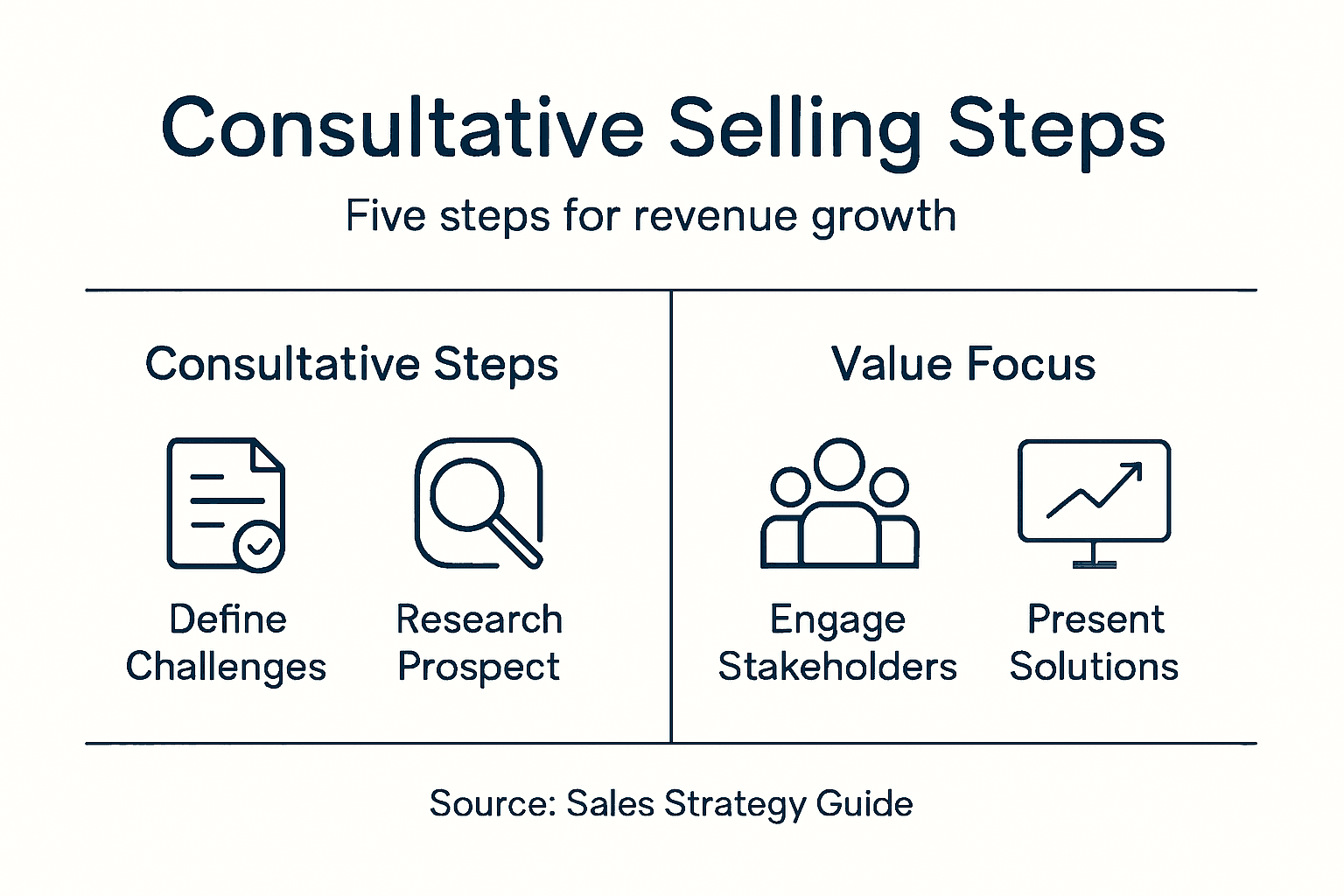
Pro tip: Prepare visual aids and concise storytelling elements that translate complex solutions into clear, actionable insights that your prospect can immediately visualise implementing.
Step 5: Validate agreement and confirm next steps
Validating agreement represents the critical moment where your consultative selling journey transitions from conversation to committed partnership. Your primary objective is to crystallise mutual understanding, establish clear expectations, and create a shared roadmap for future collaboration.
To effectively validate agreement and confirm next steps, implement these strategic approaches:
- Summarise key discussion points with precise clarity
- Document mutually agreed objectives and expected outcomes
- Establish explicit timelines and accountability metrics
- Define specific roles and responsibilities for both parties
- Create a structured follow-up communication plan
Best practices emphasise setting clear, measurable goals during the agreement phase to ensure alignment and momentum. This approach helps reduce uncertainties and builds a foundation of trust between seller and buyer.
Successful agreement validation transforms potential interest into genuine commitment.
The validation process requires a delicate balance of professionalism and collaborative spirit. By demonstrating your commitment to transparency and mutual success, you position yourself not just as a vendor, but as a strategic partner invested in their long-term objectives.
Pro tip: Create a concise, written summary of your discussion immediately after the meeting, and send it within 24 hours to reinforce shared understanding and demonstrate your proactive approach.
Unlock Revenue Growth with Consultative Selling Expertise
If defining your prospect’s true challenges and tailoring personalised sales strategies resonates with you, our expert coaching and consultancy services can elevate your sales team’s performance. Through bespoke 1:1 coaching combined with proven consultative selling techniques, we help ambitious businesses with 50 to 1000 staff generate at least 50 percent sales growth every year and consistently hit their quarterly targets. Key challenges like engaging stakeholders insightfully and presenting value-driven solutions become manageable with our tailored support.
Explore how our strategic sales training transforms your approach in alignment with the latest insights from our Sales Strategy Archives – Ahead of Sales. Embrace personalised, context-driven sales solutions by partnering with Ahead of Sales. Take the next step towards consistent revenue growth and book a consultation to discover the difference bespoke coaching can make for your team today.
Frequently Asked Questions
What are the first steps in consultative selling?
To begin consultative selling, focus on defining the prospect’s true challenges. Conduct a needs assessment by actively listening, asking open-ended questions, and researching the industry to uncover deeper insights.
How can I effectively research a prospect before a sales meeting?
Conduct comprehensive digital reconnaissance by reviewing the prospect’s business information, including recent press releases and financial statements. Allocate 30-45 minutes for this research to gather unique insights that can differentiate your approach.
What strategies can I use to engage stakeholders during a sales conversation?
Engage stakeholders by tailoring your communication for different types of stakeholders and preparing insightful questions. Focus on active listening to reflect back key insights, which helps build genuine trust and strengthens your relationships.
How do I present value-driven solutions in a consultative selling context?
Present solutions that directly align with the prospect’s identified challenges by using concrete examples and data points. Ensure your recommendations are clearly articulated in the prospect’s language to resonate deeper with their specific needs.
What should I focus on when validating agreement with a prospect?
When validating agreement, summarise the key discussion points with clarity and document mutually agreed objectives. Establish explicit timelines and a follow-up communication plan to ensure both parties are aligned moving forward.
How can consultative selling lead to increased revenue growth?
By focusing on solving clients’ challenges rather than making quick sales, consultative selling builds long-term relationships and trust. This approach enables sales professionals to offer tailored solutions that meet prospects’ needs, ultimately driving revenue growth.
2 Responses