
Over 60 percent of British companies report missed revenue targets due to hidden bottlenecks in their sales process. For every business aiming to grow, understanding where sales get stuck can spell the difference between steady profit and stalled progress. If you want practical strategies rooted in proven metrics and tailored coaching, discover how to turn your sales assessment into stronger outcomes for your British team.
Table of Contents
- Step 1: Assess Current Sales Performance And Bottlenecks
- Step 2: Define Strategic Revenue Targets And Priorities
- Step 3: Implement Tailored Sales Acceleration Techniques
- Step 4: Enhance Team Skills With Bespoke Coaching
- Step 5: Monitor Progress And Refine Growth Strategies
Quick Summary
| Key Point | Explanation |
|---|---|
| 1. Assess Sales Performance Thoroughly | Gather and analyse quantitative and qualitative data to identify bottlenecks in your sales process effectively. |
| 2. Define Strategic Revenue Targets | Establish clear, measurable revenue goals that align with your long-term business vision and priorities. |
| 3. Implement Sales Acceleration Techniques | Use tailored strategies such as real-time analytics and personalised outreach to improve sales conversion rates. |
| 4. Enhance Team Skills Through Coaching | Provide bespoke coaching to develop both technical and soft skills, fostering ongoing personal and professional growth. |
| 5. Monitor Progress and Adapt Strategies | Regularly evaluate performance using a balanced scorecard to refine strategies and drive continuous improvement. |
Step 1: Assess current sales performance and bottlenecks
Understanding your current sales performance is like taking a comprehensive health check of your business revenue stream. You will map out exactly where your sales process works smoothly and identify critical bottlenecks preventing optimal growth. By meticulously tracking sales information throughout the process, you can pinpoint precise areas requiring strategic intervention.
To conduct a thorough assessment, begin by gathering quantitative data across key performance metrics. Track lead conversion rates, average sales cycle length, win percentages, and revenue per sales representative. Use specific measurement techniques that follow SMART principles measuring aspects of utilisation, efficiency, quality, and cost. Pay special attention to stages where opportunities consistently stall or get stuck in your sales funnel. This might involve qualitative observations from your sales team combined with hard numerical data to create a comprehensive picture of performance gaps.
Consider implementing a systematic work sampling approach to monitor exactly how leads progress through different stages. Look for patterns of delay, communication breakdowns, or resource constraints that impede smooth sales progression. By understanding these specific bottlenecks, you can design targeted interventions to streamline your sales process and accelerate revenue generation.
Practical tip: Create a visual sales pipeline map highlighting each stage and potential blockage points, allowing your team to quickly identify and address performance limitations.
Here is a comparison of key sales performance metrics and what they reveal about your process:
| Metric | Insight Provided | Typical Improvement Focus |
|---|---|---|
| Lead Conversion Rate | Effectiveness of turning leads into customers | Enhance qualification and follow-up |
| Sales Cycle Length | Speed of deal closure | Remove process delays |
| Win Percentage | Success rate of closing opportunities | Improve pitch and objections handling |
| Revenue per Representative | Individual sales effectiveness | Training and resource allocation |
Step 2: Define strategic revenue targets and priorities
Defining strategic revenue targets transforms your business growth from wishful thinking to a structured, actionable plan. You will craft precise financial objectives that align with your organisation’s long-term vision and provide a clear roadmap for sustainable expansion. Strategic priorities encompass multiple dimensions of organisational performance including market positioning, innovation, productivity, and financial outcomes.
Start by conducting a comprehensive analysis of your current revenue streams and market potential. Identify key focus areas such as product development, customer acquisition, operational efficiency, and potential new market segments. Consider both quantitative metrics and qualitative insights when setting your targets. This might involve examining historical performance data, market trends, competitive landscape, and internal capabilities. Aim to establish objectives that are challenging yet achievable, using specific measurements like percentage growth, total revenue targets, or market share expansion.
Ensure your strategic revenue priorities are holistic and interconnected. Rather than viewing financial goals in isolation, consider how different objectives support and amplify each other. For instance, improving product innovation might directly impact customer acquisition rates, which in turn drives revenue growth. Break down your overarching revenue targets into specific, measurable key performance indicators that can be tracked and adjusted throughout the year.
Practical tip: Create a visual strategy map that connects your revenue targets with specific actions and metrics, allowing your team to see the direct relationship between strategic priorities and financial outcomes.
Step 3: Implement tailored sales acceleration techniques
Sales acceleration requires a strategic approach that transforms your current processes into high-performance systems. Your goal is to design targeted techniques that systematically reduce friction in your sales pipeline and dramatically improve conversion rates. Real-time sales analytics can powerfully address operational bottlenecks and enhance overall sales execution by providing immediate insights into performance dynamics.

Begin by mapping your entire sales funnel and identifying specific stages where potential customers lose momentum or disengage. Analyse performance metrics across different product lines, sales representatives, and geographical regions to pinpoint precise improvement opportunities. This might involve implementing advanced tracking mechanisms that monitor lead progression, conversion rates, and customer interaction patterns. Focus on developing personalised outreach strategies that align with individual customer needs, leveraging data insights to create more targeted and compelling sales approaches.
Integrate technology and human expertise to accelerate your sales process. Utilise customer relationship management systems, predictive analytics tools, and communication platforms that streamline interactions and provide real-time performance visibility. Train your sales team to use these technologies effectively, ensuring they can interpret data insights and adapt their strategies dynamically. Create feedback loops that allow continuous learning and refinement of your sales acceleration techniques, enabling your organisation to stay agile and responsive to changing market conditions.
Practical tip: Develop a monthly sales acceleration scorecard that tracks key performance indicators and highlights both individual and team progress towards your strategic revenue targets.
The table below summarises tailored sales acceleration approaches and their business impacts:
| Sales Acceleration Technique | Description | Business Impact |
|---|---|---|
| Real-time Sales Analytics | Immediate tracking of sales activities | Faster issue identification |
| Personalised Outreach | Customised approaches for each customer | Higher engagement and conversions |
| CRM and Predictive Tools | Technology to manage and forecast sales | Improved process efficiency |
| Ongoing Training and Feedback | Regular skills development and coaching | Sustained team performance growth |
Step 4: Enhance team skills with bespoke coaching
Bespoke coaching represents a transformative approach to elevating your sales team’s performance through personalised skill development. Effective pipeline management requires systematic data collection and targeted skill improvement that addresses specific performance gaps and individual strengths across your sales organisation.
Initiate your coaching programme by conducting comprehensive individual assessments that evaluate each team member’s current capabilities, communication styles, and potential growth areas. This nuanced approach allows you to design tailored learning experiences that resonate with each sales representative’s unique learning style and professional aspirations. Focus on developing both technical skills such as negotiation techniques and product knowledge, and soft skills including emotional intelligence, active listening, and relationship building. Create structured learning pathways that combine theoretical training, practical workshops, role playing scenarios, and one-to-one mentoring sessions to ensure holistic skill development.
Implement a continuous feedback and measurement system that tracks the impact of your coaching interventions. Establish clear performance benchmarks and regularly review progress, allowing for dynamic adjustment of coaching strategies. Encourage a culture of continuous learning where sales team members view coaching as an opportunity for professional growth rather than a remedial intervention. Integrate peer learning mechanisms, allowing high performers to share insights and strategies, thereby creating a collaborative environment that drives collective skill enhancement.
Practical tip: Design individual development plans that include specific, measurable objectives aligned with both personal career goals and organisational performance targets.
Step 5: Monitor progress and refine growth strategies
Monitoring your revenue growth requires a systematic and comprehensive approach that transcends simple number tracking. The balanced scorecard provides a robust framework for evaluating organisational performance across multiple critical perspectives, enabling you to gain nuanced insights into your strategic progress and potential improvement areas.
Develop a sophisticated monitoring system that integrates both leading and lagging performance indicators. This means tracking not just final revenue numbers, but also predictive metrics such as sales pipeline health, customer engagement levels, conversion rates, and team skill development progress. Establish clear SMART objectives that are specific, measurable, achievable, relevant, and time bound. Create regular review cycles where you analyse these metrics collaboratively with your leadership team, discussing not just the numbers but the underlying dynamics driving performance. Look for patterns, anomalies, and potential opportunities for strategic refinement.
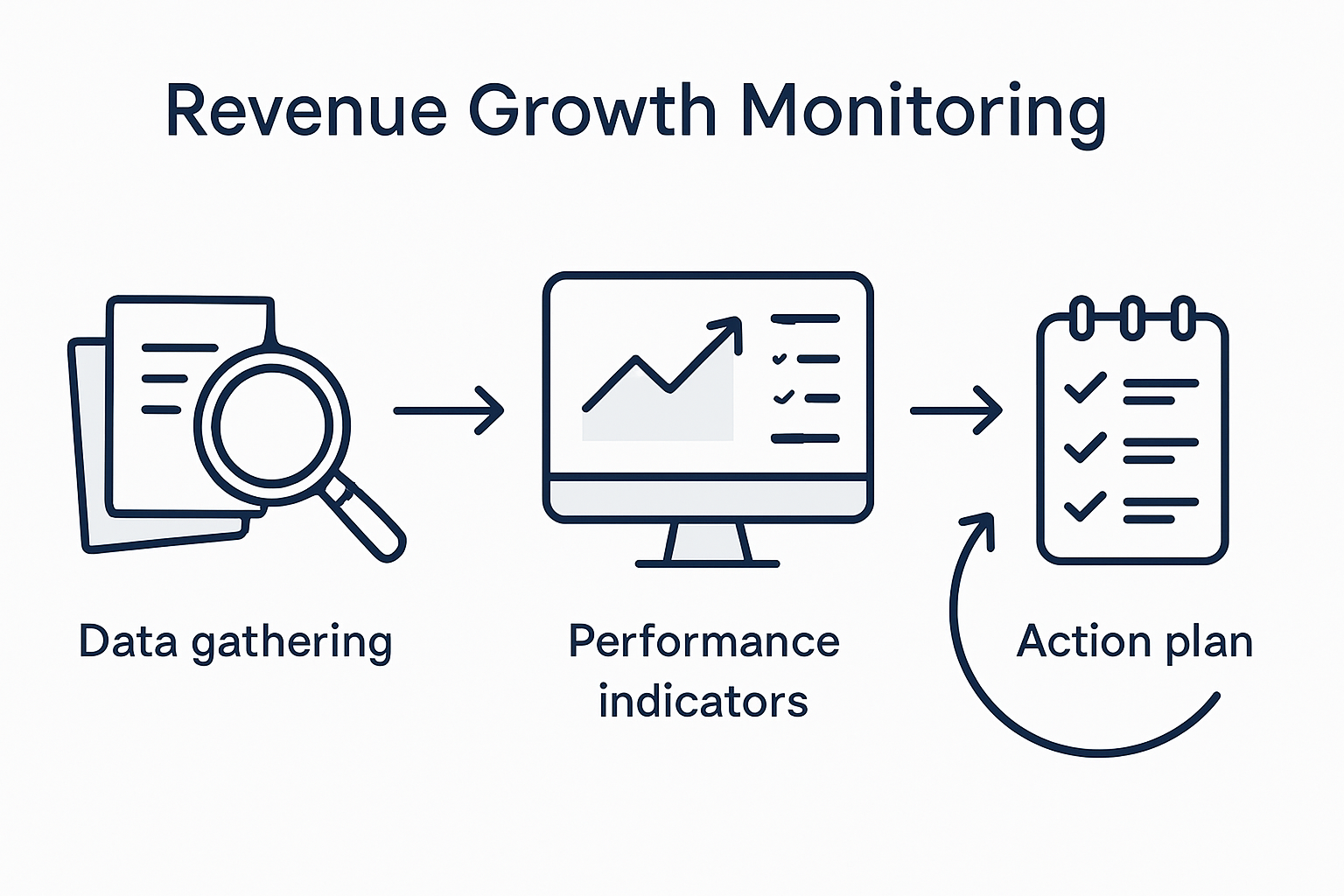
Embrace a dynamic and adaptive approach to strategy management. Your growth strategy should be viewed as a living document that evolves based on real world performance data. When certain initiatives are not delivering expected results, be prepared to pivot quickly. This might involve reallocating resources, adjusting sales techniques, investing in additional training, or exploring new market segments. Cultivate a culture of continuous improvement where data drives decision making and every team member understands how their individual performance contributes to broader organisational goals.
Practical tip: Implement a quarterly strategy review meeting where you comprehensively assess performance, celebrate successes, and collaboratively develop actionable refinement strategies.
Accelerate Your Sales Growth with Expert Coaching and Proven Strategies
If you found value in understanding how to accelerate revenue growth step-by-step including assessing sales performance and implementing tailored acceleration techniques, imagine what bespoke 1:1 coaching combined with expert training could do for your team. Many businesses struggle with bottlenecks in their sales pipeline, difficulty defining strategic revenue targets and enhancing team skills effectively. Our approach directly addresses these challenges through personalised development plans and real-time insights to ensure your sales team consistently hits target.
Explore our tailored solutions that align perfectly with the strategic priorities highlighted in this guide. Whether you lead a medium-sized company or a solo service business, our sales acceleration packages are designed to deliver measurable growth of at least 50 percent annually. Start transforming stalled opportunities into closed deals by visiting Sales Strategy Archives – Ahead of Sales. For an overall introduction to how we can drive your sales performance see Ahead of Sales. Discover practical insights and actionable tactics within our Sales Playbook Archives – Ahead of Sales. Take the next step today to power your revenue growth with proven expertise.
Frequently Asked Questions
How can I assess my current sales performance effectively?
To assess your current sales performance, gather quantitative data such as lead conversion rates, sales cycle length, and win percentages. Map out your sales process to identify bottlenecks and monitor stages where prospects get stuck. Start by tracking these key metrics over a 30-day period to find areas for improvement.
What steps should I take to define my revenue targets and priorities?
Begin by analysing your current revenue streams and market potential. Set challenging yet achievable objectives using specific measurements like percentage growth and total revenue targets. Craft a visual strategy map to connect your revenue targets with actionable steps within the next quarter.
What are effective sales acceleration techniques I can implement?
Implement personalised outreach strategies and utilise real-time sales analytics to identify bottlenecks in your sales funnel. Map your entire sales process and focus on stages where potential customers lose interest. Aim to streamline interactions and enhance engagement methods within the next month.
How can I enhance my sales team’s skills through coaching?
Conduct individual assessments to identify each team member’s strengths and areas for growth. Design tailored coaching programmes that combine technical and soft skill development through practical workshops and mentoring sessions. Ensure that you establish clear objectives for skill enhancement over a six-month period.
What should I monitor to refine my growth strategies?
Monitor both leading and lagging indicators such as sales pipeline health, conversion rates, and customer engagement levels. Establish SMART objectives and review them collaboratively with your team on a quarterly basis. Be prepared to pivot your strategies based on performance insights to adapt quickly to market changes.
How often should I review my revenue growth strategies?
Conduct a comprehensive strategy review meeting every quarter to assess performance, celebrate successes, and identify areas for refinement. This regular review process ensures that your growth strategy remains dynamic and responsive to real-world data. Additionally, be open to adjusting your tactics whenever necessary.
Recommended
- 7 Proven Sales Acceleration Strategies for Rapid Growth – Ahead of Sales
- How to Shorten Sales Cycles for Rapid Growth – Ahead of Sales
- Sales Team Management Workflow for Sustainable Growth – Ahead of Sales
- 7 Essential Sales Leadership Tips for Fast Growth – Ahead of Sales
- 7 Key Examples of Cannabis Revenue Streams Explained – Cannabis Business Minds
- Understanding the Role of Growth Tracking in Success – Optio Station: Best Project Management App for Prioritization