
TL;DR:
- B2B sales involves complex decision-making processes, long cycles, and a focus on ROI and relationships. Understanding buyer behavior and stakeholder engagement is essential for UK businesses to achieve sustainable growth. Adopting appropriate methodologies and models tailored to your market can significantly improve sales outcomes in 2026.
Most people assume B2B sales is simply one company selling to another. It is, technically. But that definition misses everything that makes it genuinely challenging and strategically fascinating. B2B sales is characterised by larger deal sizes, longer sales cycles, multiple decision-makers, and a relentless focus on ROI and long-term relationships. If you lead a mid-sized UK business and your team is not winning at the rate you expect, chances are the gap is not effort. It is a deeper misunderstanding of what B2B sales actually demands, and how it must be approached in 2026.
Table of Contents
- What B2B sales truly means
- The B2B sales process: stages and timeframes
- B2B sales methodologies: how top teams succeed
- B2B sales models and edge cases
- What most guides miss about B2B sales in the UK
- Enable your team with proven B2B sales support
- Frequently asked questions
Key Takeaways
| Point | Details |
|---|---|
| B2B means complexity | B2B sales involve extended cycles, multiple decision-makers, and a strong focus on relationship-building. |
| Process shapes success | Clear, evidence-based sales stages and methodologies drive repeatable revenue growth. |
| Methodology must fit | Effective B2B sales strategies are aligned with the buyer’s journey and must adapt to shifts in buyer behaviour. |
| Model choice matters | Choosing the right B2B sales model boosts efficiency and win rates for your sales team. |
What B2B sales truly means
Now that we have surfaced the need for a deeper understanding, let us define precisely what B2B sales encompasses and how it stands apart from other sales models.
At its core, B2B sales is a commercial exchange between two businesses. But that framing barely scratches the surface. Think about the last time your team pursued a significant deal. There were probably multiple stakeholders involved, each with different priorities. The procurement team wanted cost control. The operations director wanted reliability. The CEO wanted strategic value. That complexity is what separates B2B sales from almost everything else in commerce.
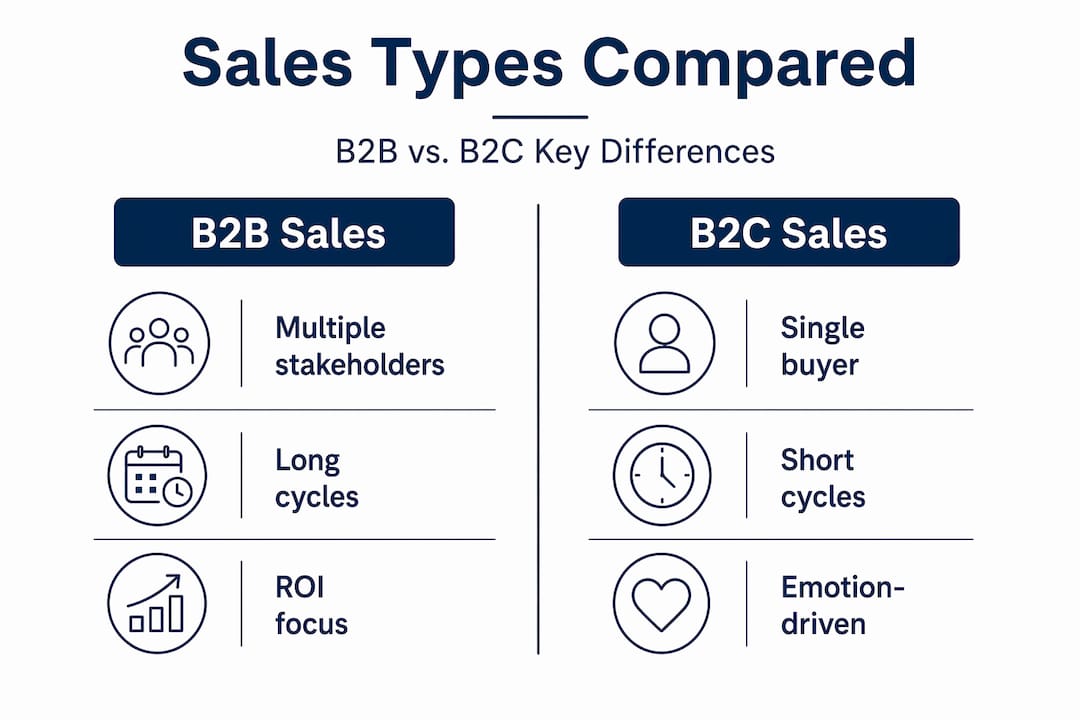
One of the most common misconceptions I see in mid-sized UK firms is treating B2B sales the same way you would treat a consumer-facing sales approach. You cannot rely on emotional impulse or urgency-driven tactics. B2B sales contrasts sharply with B2C by emphasising rational ROI over emotion, navigating multiple stakeholders rather than a single buyer, and managing long complex cycles instead of quick decisions. This demands consultative approaches over transactional ones.
Here is a clear comparison to frame the difference:
| Factor | B2B sales | B2C sales |
|---|---|---|
| Decision-makers | Multiple (3 to 13+) | Usually one |
| Sales cycle | Weeks to 18+ months | Minutes to days |
| Deal value | High | Low to medium |
| Buying motivation | ROI, efficiency, risk | Emotion, convenience |
| Relationship importance | Very high | Low to moderate |
| Sales approach | Consultative | Transactional |
For UK businesses operating in sectors like technology, professional services, manufacturing, or logistics, this distinction is not academic. It is the difference between a sales team that consistently hits target and one that constantly chases its tail. Understanding the B2B franchise model can also help context-set for businesses exploring scalable routes to market.
If you want sustainable growth, you need your sales strategy built around how B2B buyers actually think, not how you wish they would behave. Our B2B sales strategy guide walks through exactly how to build that foundation.
The B2B sales process: stages and timeframes
With a clear definition in mind, it is essential to see how the full B2B sales process unfolds step by step for UK firms.
The modern B2B sales process is not linear, but it does follow a recognisable pattern. According to Highspot, the core B2B sales stages are: targeting and research, prospecting and first meeting, diagnosis and value hypothesis, solutioning and demonstration, negotiation, close, and post-sale. Each stage demands different skills, tools, and levels of stakeholder engagement.
Here is what each stage looks like in practice:
- Targeting and research — Identify ideal customer profiles (ICPs) and research accounts before a single outreach is made.
- Prospecting and first meeting — Engage decision-makers through outbound, referrals, or inbound, then secure an initial conversation.
- Diagnosis and value hypothesis — Ask sharp questions to understand the buyer’s challenges and form a provisional value proposition.
- Solutioning and demo — Present your solution in a way that directly addresses what you learned in diagnosis, not a generic product walkthrough.
- Negotiation — Work through commercial, contractual, and stakeholder objections.
- Close — Confirm agreement, sign contracts, and handle final approvals.
- Post-sale — Onboard effectively, deliver on promises, and create conditions for expansion and referral.
Now here is something that often surprises business leaders when they see it for the first time. The average B2B buying cycle in the UK is 281 days, and cost per lead (CPL) averages £160, rising to £650 or more depending on the industry. That is nearly ten months from first contact to signed contract, with significant investment in lead generation at every stage.
This has massive implications for how you plan revenue. If your team is only focusing on deals that are near the bottom of the funnel, you are not building a healthy pipeline. You are hoping. A well-managed B2B sales process requires activity across every stage simultaneously, with clear visibility of how long deals typically take to progress.
The stakeholder challenge makes this even more demanding. Enterprise deals routinely involve double-digit decision-makers, each needing to be engaged at the right time with the right message. Ignore one key influencer and they can quietly kill a deal weeks before the expected close date.
You can use our B2B sales checklist to make sure your team is executing each stage consistently. If you are selling software or technology solutions, our SaaS sales process guide covers the unique dynamics of that model in detail. For businesses exploring new routes to market, it is also worth reviewing B2B franchise opportunities as an alternative growth channel.
B2B sales methodologies: how top teams succeed
Understanding process stages is crucial, but adopting the right sales methodology can be the game changer for consistently winning B2B deals.

A sales methodology is not just a framework you print and laminate. It is the thinking structure that guides how your team engages buyers, qualifies opportunities, and drives decisions. The problem is most sales leaders pick a methodology once and never revisit whether it actually fits their current market.
Here are the most widely used B2B sales methodologies and when each works best:
- BANT (Budget, Authority, Need, Timeline) — Good for early-stage qualification when you need to filter volume quickly. Works best in transactional or shorter-cycle sales.
- MEDDIC (Metrics, Economic Buyer, Decision Criteria, Decision Process, Identify Pain, Champion) — Excellent for enterprise sales where multiple stakeholders and complex decisions are involved.
- SPIN Selling — Built around four question types (Situation, Problem, Implication, Need-Payoff). Highly effective for consultative conversations that uncover deep buyer pain.
- Challenger Sales — Encourages reps to teach, tailor, and take control. Works well when buyers are entrenched in the status quo and need a fresh perspective.
- Consultative Selling — Positions the salesperson as a trusted adviser rather than a vendor. Ideal for complex or relationship-led sales environments.
- Social Selling — Uses LinkedIn and other platforms to build credibility and relationships before direct outreach. Works best as a complement to other methodologies, not a standalone approach.
What separates high-performing teams from average ones is not which methodology they choose. It is how rigorously they embed it. Methodologies fail without buyer-aligned architecture, timing focus, and feedback loops. More specifically, engaging the economic buyer early can boost win rates by as much as 307%. That figure alone should change how you prioritise conversations in the early stages of a deal.
Pro Tip: The economic buyer is not always the most senior person in the room. In many UK mid-sized companies, it is a finance director or divisional head with budget sign-off who sits outside the initial conversation. Map them early, even if you are not speaking to them directly yet.
If you want to go deeper on the approach that delivers the most consistent results for complex B2B environments, start with consultative selling and understand the advantages it brings for both your win rate and your client relationships.
B2B sales models and edge cases
After exploring methodologies, it is helpful to understand the different models of B2B sales, because no single approach fits every business.
The model your business uses shapes everything from how you structure your team to how long your average deal takes and what kind of salespeople you need to hire. Here is a breakdown of the main B2B sales models and what makes each distinctive:
- Transactional — Short cycles, lower deal values, often repeat purchases. Think office supplies, maintenance contracts, or commoditised services. Speed and efficiency matter most here.
- Consultative — Medium to long cycles, relationship-led, solution-focused. Common in professional services, HR, and training. Requires skilled questioning and account management.
- Enterprise — Complex, high value, involving 13 or more stakeholders, cycles of 6 to 18+ months. Needs dedicated account executives, structured stakeholder maps, and executive sponsorship.
- Channel and partner — Selling through resellers, distributors, or referral partners. Requires strong enablement and joint-selling disciplines.
- Self-service — Buyers complete most or all of the purchase journey themselves, often online. Common in SaaS and lower-value digital products.
The real-world impact of choosing the wrong model is significant. I have seen consultative sales teams trying to operate enterprise accounts without the right support structure, burning out and losing deals they should have won. I have also seen enterprise-trained reps applied to transactional accounts, over-engineering simple decisions and slowing everything down.
Pro Tip: Review your sales model fit every year. Markets shift, your client base evolves, and the model that worked well in 2023 may not be the right fit for where your business is heading in 2026. This is not optional housekeeping. It is strategic maintenance.
If long sales cycles are currently limiting your growth, there are specific strategies for shortening those cycles without compromising on deal quality. It is also worth exploring how B2B marketing can be aligned with your sales model to generate better-qualified opportunities from the start.
What most guides miss about B2B sales in the UK
With the technical landscape mapped, here is a view from the trenches that spotlights what truly drives B2B sales growth today.
Most articles on B2B sales present frameworks as if applying them is straightforward. In practice, especially in the UK market, there are nuances that templates simply cannot capture.
The UK B2B environment has some specific characteristics worth understanding. Decision-making culture here tends to be more risk-averse and consensus-driven than in the US, for example. That means stakeholder mapping and building internal champions inside your target accounts is not just useful, it is essential. A champion who genuinely believes in your solution can navigate the internal politics that would otherwise stall your deal indefinitely.
I also think there is a dangerous over-reliance on process templates right now. Leaders invest in a CRM, build a sales playbook, and assume the machinery will do the work. It will not. Agile adaptation and genuine feedback loops are what keep a sales team sharp. If you are not regularly reviewing why you are losing deals, not just how many you are losing, you are flying blind.
The economic buyer engagement point deserves repeating, because almost every team I work with is getting this wrong. They spend weeks building rapport with a product champion or middle manager, and the economic buyer only enters the conversation at the negotiation stage. By then, you have lost months of opportunity to shape their perception, address their concerns, and build the commercial case on their terms. Engage the economic buyer early. Even if indirectly, even if it is through your champion.
Understanding how sales consultancy drives growth for UK businesses can also help you identify where external expertise fills the gaps that internal teams find difficult to see in themselves.
The businesses I see hitting 50% annual growth are not the ones with the most sophisticated CRM or the most comprehensive sales playbook. They are the ones with teams that listen precisely, adapt quickly, and stay relentlessly focused on the buyer’s actual priorities rather than their own sales agenda.
Enable your team with proven B2B sales support
Ready to put these insights to work? Here is how we can help accelerate your B2B growth journey.
If this article has clarified the real complexity of B2B sales and you are thinking about where your team’s biggest gap is right now, you are asking exactly the right question. At Ahead of Sales, we work with mid-sized UK businesses to build the processes, skills, and habits that generate at least 50% sales growth each year and ensure teams hit target every quarter.
Whether your challenge is methodology alignment, stakeholder management, pipeline health, or shortening your sales cycle, our bespoke coaching and training is designed around your specific situation, not a generic curriculum. Explore our sales acceleration packages and discover how we tailor support for businesses at every stage of the growth journey. Or take a closer look at our full range of sales training services to see what fits your team’s current needs.
Frequently asked questions
How is B2B sales different from B2C?
B2B sales involves multiple decision-makers, rational buying based on ROI, longer cycles, and larger deal sizes, whereas B2C relies on quicker, often emotional purchase decisions made by a single buyer.
What is the average B2B sales cycle length in the UK?
The average B2B buying cycle in the UK is 281 days, though this varies significantly depending on industry sector and deal complexity.
Which sales methodologies work best for B2B?
The most effective B2B sales methodologies include Consultative Selling, SPIN Selling, Challenger Sales, BANT, and MEDDIC, with the best choice depending on your deal complexity and cycle length.
What does CPL mean in B2B sales?
CPL stands for Cost Per Lead. The UK average B2B CPL is £160, rising to £650 or more in competitive industries, making it a critical metric for measuring sales and marketing efficiency.
How many stakeholders are involved in a typical B2B deal?
Enterprise B2B deals can involve 13 or more stakeholders, though the exact number varies by sales model, deal size, and the complexity of the buying organisation.