
Over 60 percent of British B2B companies report struggling to pinpoint their ideal customers, even with robust data on hand. The gap between knowing your market and converting that knowledge into real revenue can leave even experienced sales teams frustrated. If you want a sales strategy built for long-term results, understanding the British approach to targeted B2B selling offers powerful lessons for creating precise customer profiles, sharper messaging, and consistent sales growth.
Table of Contents
- Stage 1: Define Your Ideal B2B Customer Profile
- Stage 2: Develop Tailored Value Propositions And Messaging
- Stage 3: Build A High-Performance Sales Process
- Stage 4: Implement Data-Driven Lead Generation Tactics
- Stage 5: Monitor Results And Optimise Sales Performance
Quick Summary
| Key Message | Explanation |
|---|---|
| 1. Define your ideal customer profile | Understand firmographics and key characteristics of your best customers to maximise sales growth efforts. |
| 2. Tailor value propositions effectively | Align your offerings with specific customer pain points to create compelling and effective communication. |
| 3. Establish a structured sales process | Develop a clear sales methodology to streamline opportunities and improve revenue generation consistency. |
| 4. Use data-driven lead generation | Implement robust tracking and scoring models to attract and prioritise high-quality leads effectively. |
| 5. Monitor and optimise sales performance | Continuously assess key metrics and gain insights to improve sales strategies and enhance team performance. |
Stage 1: Define your ideal B2B customer profile
Identifying your ideal B2B customer profile is the strategic cornerstone of sustainable sales growth. This pivotal process helps you focus your resources precisely where they generate maximum returns.
To craft a robust customer profile, you must go beyond surface demographics. Research from German B2B companies demonstrates the critical importance of understanding firmographic variables that influence purchasing decisions. Start by analysing your existing customer base and examining common characteristics such as industry sector, company size, annual revenue, technological infrastructure, and organisational challenges.
When developing your profile, consider both quantitative and qualitative factors. B2B marketing fundamentally involves understanding organisations that purchase products to produce other services, which means drilling deeper than traditional consumer profiling. Look for patterns in decision making processes, pain points, strategic objectives, and growth trajectories.
Pro tip: Create a detailed ideal customer persona document that includes not just statistical data, but also narrative insights about their business challenges, aspirations, and potential interaction points with your solution. This approach transforms a generic profile into a living, breathing representation of your most valuable potential clients.
Once you have a clear profile, you will be positioned to align your sales strategy, messaging, and value proposition with laser precision.
Stage 2: Develop tailored value propositions and messaging
Crafting a compelling value proposition is the strategic art of demonstrating exactly how your solution solves specific customer challenges. This critical step transforms generic sales pitches into powerful, targeted communication that resonates deeply with potential clients.
Quantifying and communicating value in B2B markets requires a nuanced approach that goes beyond surface level features. Begin by mapping each customer segment’s unique pain points and aligning your value proposition to address those precise challenges. This means understanding not just what your product does, but how it specifically alleviates organisational problems and drives tangible business outcomes.
Research highlights that creating and communicating value promises represent key challenges for companies seeking to enhance customer satisfaction. To develop an exceptional value proposition, focus on translating technical capabilities into clear business benefits. Quantify your impact wherever possible using metrics like potential cost savings, efficiency improvements, or revenue acceleration.
Pro tip: Structure your messaging using a three part framework. First, articulate the specific problem. Second, explain your unique solution. Third, demonstrate measurable outcomes. This approach transforms abstract promises into concrete value that speaks directly to decision makers.
Remember that truly effective value propositions are living documents. Continuously refine your messaging based on customer feedback, market shifts, and evolving business landscapes.
Stage 3: Build a high-performance sales process
Constructing a high-performance sales process is about creating a strategic roadmap that transforms potential opportunities into consistent revenue generation. This systematic approach ensures your sales team operates with precision and predictability.
Understanding organisational purchasing behaviours is fundamental to designing an effective sales methodology that resonates with your target market. Begin by mapping out each critical stage of your customer journey, from initial contact through to final contract closure. Identify key decision points, potential friction areas, and opportunities for meaningful engagement.

Effective B2B sales processes require a nuanced approach that communicates and delivers genuine value to customers. Develop a structured workflow that includes clear qualification criteria, comprehensive lead scoring mechanisms, and robust tracking systems. This ensures your team focuses energy on high potential prospects while maintaining a disciplined approach to sales engagement.
Pro tip: Implement a consistent documentation strategy where every interaction customer interaction is meticulously recorded. This creates institutional knowledge that can be leveraged for continuous process improvement and training.
Remember that a high performance sales process is never static. Regularly review performance metrics, gather team feedback, and be prepared to adapt your approach as market dynamics evolve.
Stage 4: Implement data-driven lead generation tactics
Data-driven lead generation transforms scattered prospecting efforts into a precision instrument of business growth. Your objective is to convert raw information into strategic insights that consistently attract high-quality potential customers.
B2B marketing strategies fundamentally depend on understanding customer needs through comprehensive data analysis, which means moving beyond surface level demographic information. Start by implementing robust tracking mechanisms across all customer interaction points including website behaviour, social media engagement, content consumption patterns, and response rates to targeted communications.
Quantifying value through data-driven approaches enables more effective lead generation and sales targeting. Develop a sophisticated lead scoring model that assigns numerical values to prospect interactions, allowing your team to prioritise opportunities with the highest potential conversion probability. This requires integrating multiple data sources including firmographic details, behavioural signals, and predictive analytics.
Pro tip: Invest in advanced customer relationship management systems that provide real time insights and enable granular segmentation. The more precisely you can understand and predict potential customer behaviour, the more efficiently you can allocate sales resources.
Remember that data-driven lead generation is an iterative process. Continuously refine your models, test new approaches, and remain adaptable to emerging market signals.
Stage 5: Monitor results and optimise sales performance
Tracking and optimising sales performance transforms raw data into strategic insights that drive continuous improvement. Your goal is to create a dynamic feedback loop that consistently elevates your team’s effectiveness and revenue generation capabilities.
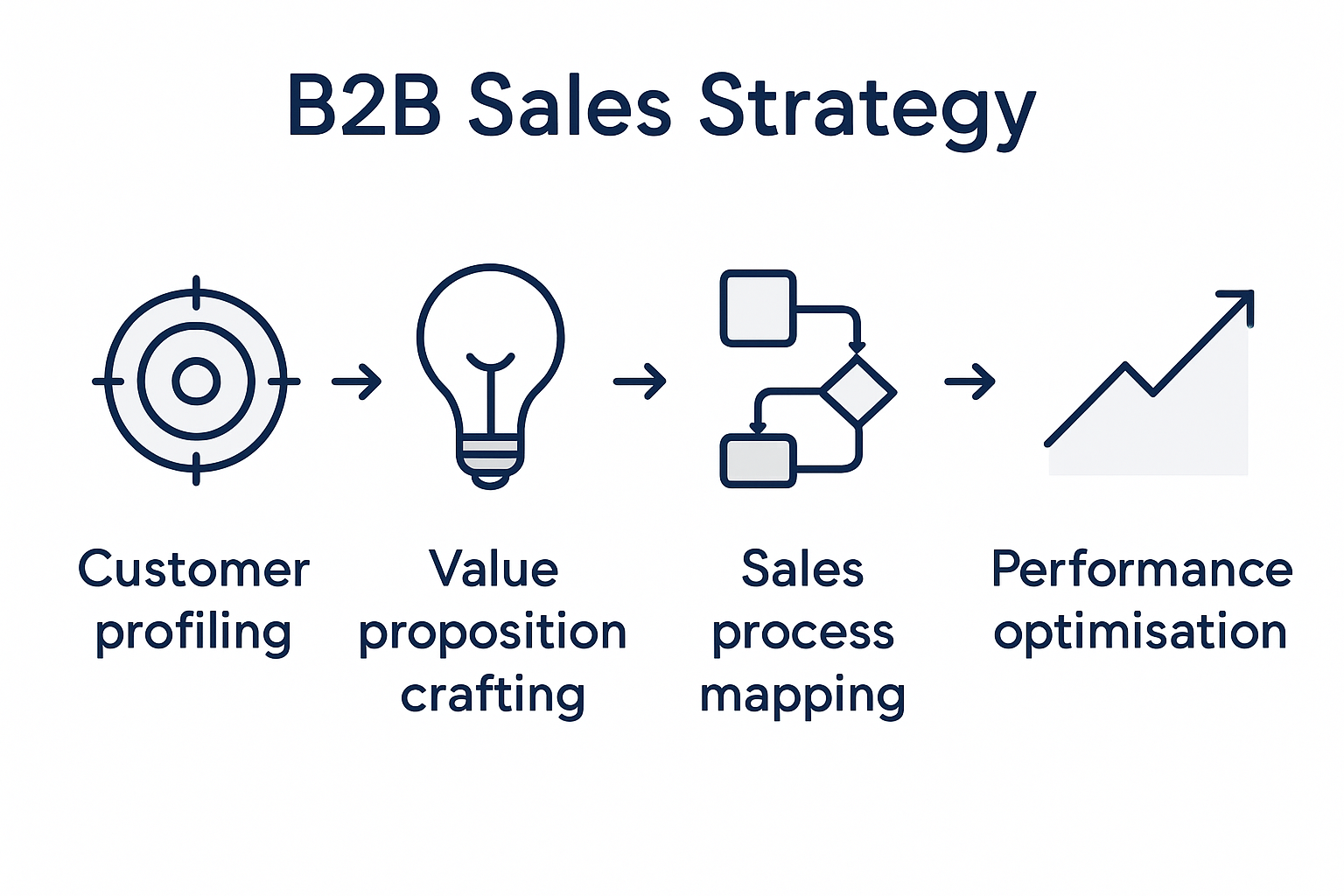
B2B marketing strategies require ongoing assessment and adaptation to maintain competitive edge, which means implementing a comprehensive monitoring system that goes beyond traditional performance metrics. Establish a robust framework that captures both quantitative outcomes like conversion rates and revenue, and qualitative indicators such as customer satisfaction, sales team engagement, and strategic alignment.
Measuring and communicating value represents a critical component of sustainable sales performance. Develop a sophisticated dashboard that integrates multiple data streams, enabling real time visibility into key performance indicators. This should include lead generation efficiency, sales cycle length, average deal size, win rates, and customer acquisition costs.
Pro tip: Implement a quarterly performance review process where data insights are transparently shared with the entire sales team. This creates a culture of accountability, continuous learning, and collaborative improvement.
Remember that sales performance optimization is an evolving journey. Stay curious, remain open to experimentation, and be prepared to pivot your strategies based on emerging insights.
Achieve Exponential B2B Sales Growth with Proven Strategies
Many businesses struggle to define their ideal customer profile, craft tailored value propositions, and build a sales process that consistently hits targets. This guide highlights key challenges such as aligning messaging with customer pain points and implementing data-driven lead generation tactics. With Ahead of Sales, you gain access to bespoke 1:1 coaching and expert consultancy designed to overcome these hurdles and help your sales team deliver measurable results every quarter.
Why settle for uncertain sales growth when you can harness a structured approach that drives success
Explore our Sales Strategy Archives – Ahead of Sales to discover how tailored strategies empower businesses like yours. Ready to transform your sales performance? Visit Ahead of Sales to learn about our packages for companies with growth ambitions and connect with our expert team. Take the first step to ensure your sales teams consistently exceed targets and unlock sustained revenue growth. For practical tactics and insights, also check out our Sales Playbook Archives – Ahead of Sales.
Frequently Asked Questions
How do I define my ideal B2B customer profile?
To define your ideal B2B customer profile, start by analysing your existing customer base and identifying common characteristics such as industry sector, company size, and revenue. Compile this information into a detailed document that outlines pain points and decision-making processes to create a clear representation of your most valuable potential clients.
What are effective strategies for developing tailored value propositions?
Effective strategies for developing tailored value propositions include identifying customer pain points and aligning your solutions to address these challenges. Use a three-part framework: outline the specific problem, articulate your unique solution, and demonstrate measurable outcomes to clearly communicate the benefits of your offerings.
How can I build a high-performance sales process?
To build a high-performance sales process, map out each critical stage of your customer journey, identifying key decision points and engagement opportunities. Create structured workflows with clear qualification criteria and tracking systems to ensure your sales team focuses on high-potential prospects.
What are data-driven tactics for lead generation in B2B sales?
Data-driven lead generation tactics involve implementing robust tracking mechanisms to analyse customer interactions and behaviours. Develop a lead scoring model to prioritise opportunities with the highest conversion potential and continually refine your approach based on data insights.
How do I monitor results and optimise sales performance?
To monitor results and optimise sales performance, establish a comprehensive system that tracks both quantitative and qualitative metrics. Conduct quarterly performance reviews to share insights with your sales team, fostering a culture of continuous learning and improvement.
Why is understanding firmographic variables important for B2B marketing?
Understanding firmographic variables is crucial for B2B marketing because these factors influence purchasing decisions within organisations. By analysing attributes like company size, industry, and technological infrastructure, you can tailor your approach and messaging to resonate with potential clients.
Recommended
- Sales Strategy Explained: Comprehensive Growth Blueprint – Ahead of Sales
- B2B SaaS Sales Explained: Complete Process and Models – Ahead of Sales
- Sales Best Practices: Driving Consistent Revenue Growth
- B2B SaaS Sales Training | SaaS Sales Training | UK – Ahead of Sales
- How to Set Business Goals for Measurable Growth Success – Projector Display
- Understanding the B2B Content Strategy Framework
- Business Growth Strategies Explained: Complete Overview – Click Thrive Marketing
Thank you very much for this great post.
Pleasure, thank you for your comments!