
Most sales teams succeed or fail based on the quality of their leadership. With research showing that only about 22 percent of sales leaders feel truly confident in their team’s ability to meet ambitious goals, it is clear that effective leadership shapes measurable business outcomes. Understanding what defines strong sales leadership, including the unique skills and approaches top leaders use, helps organisations develop teams that drive consistent growth and lasting success.
Table of Contents
- Defining The Role Of Sales Leadership
- Key Sales Leadership Styles And Approaches
- Essential Skills And Qualities For Success
- Strategic Influence On Sales Performance
- Common Mistakes And How To Avoid Them
Key Takeaways
| Point | Details |
|---|---|
| Sales Leadership as a Strategic Role | Effective sales leaders must act as strategic architects, focusing on talent development, performance standards, and revenue growth alignment with organizational goals. |
| Diverse Leadership Styles | Successful leaders blend various leadership styles, adapting to team dynamics and situations to foster high performance and engagement. |
| Essential Skills for Success | Key skills include strategic influence, emotional intelligence, and analytical proficiency to drive team and organizational growth. |
| Common Pitfalls to Avoid | Leaders should avoid micromanagement and inconsistent communication to promote trust, accountability, and long-term team development. |
Defining the Role of Sales Leadership
Sales leadership represents a critical strategic function that goes far beyond traditional management responsibilities. According to Jobs Community, a Sales Leader is fundamentally responsible for steering sales teams towards achieving organisational objectives while embodying the company’s core vision.
The role encompasses multiple sophisticated dimensions. Sales leaders must simultaneously act as strategic architects, performance catalysts, and cultural architects. They are tasked with designing comprehensive sales strategies, nurturing talent, establishing performance standards, and creating an environment that drives consistent revenue growth. Academic Research highlights this evolving landscape, demonstrating how modern sales leadership transcends mere supervision.
Key responsibilities of effective sales leadership include:
- Developing robust sales strategies aligned with business goals
- Recruiting, training, and mentoring high-potential sales talent
- Implementing performance measurement and coaching systems
- Creating a motivational culture of continuous improvement
- Driving strategic decision-making based on market insights
- Ensuring cross-functional alignment between sales and other departments
Successful sales leaders understand that their role is not about micromanaging but empowering their teams. They create frameworks where individual sales professionals can excel, transforming potential into predictable, scalable revenue generation. By balancing strategic oversight with personalised support, these leaders become the critical bridge between organisational vision and practical sales execution.
Key Sales Leadership Styles and Approaches
Sales leadership encompasses a diverse range of approaches, each with unique characteristics and potential impacts on organisational performance. Digital Defynd highlights several critical leadership styles that define how sales leaders interact with and motivate their teams.
Four primary sales leadership styles emerge as particularly significant:
Here’s a comparison of the four key sales leadership styles:
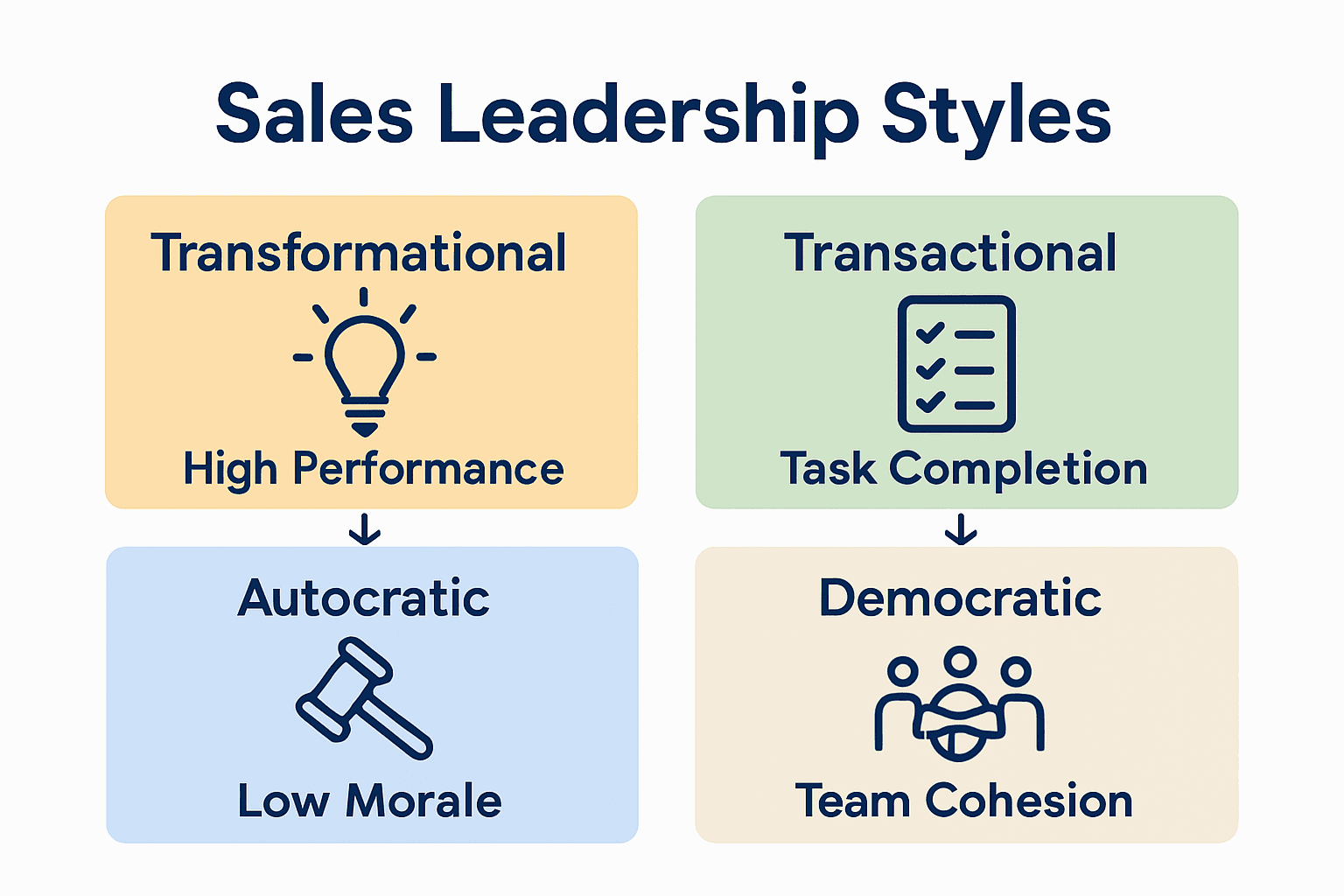
| Leadership Style | Main Focus | Team Involvement | Typical Outcomes |
|---|---|---|---|
| Transformational | Inspiration & Innovation | High collaboration | Team growth Continuous progress |
| Transactional | Rewards & Penalties | Moderate, performance-led | Short-term results |
| Autocratic | Directive, Top-down control | Minimal | Fast decisions Reduced buy-in |
| Democratic | Shared decision-making | High collaboration | High morale Stronger engagement |
- Transformational Leadership
- Focuses on inspiring and motivating team members
- Encourages personal and professional growth
- Drives innovation and continuous improvement
- Transactional Leadership
- Emphasises clear performance expectations
- Relies on structured reward and punishment systems
- Prioritises short-term performance metrics
- Autocratic Leadership
- Characterized by top-down decision-making
- Minimal input from team members
- Strong control and directive management
- Democratic Leadership
- Collaborative approach
- Encourages team input and consensus
- Promotes shared decision-making processes
Effective sales leaders often blend these styles strategically, recognising that no single approach suits all situations. Sales Team Effectiveness Tutorial suggests that adaptability is crucial. The most successful leaders understand their team’s unique dynamics, individual motivations, and organisational context, allowing them to dynamically shift between leadership approaches.
Ultimately, the most powerful sales leadership transcends rigid methodologies. It requires emotional intelligence, strategic thinking, and a deep understanding of how to unlock individual and collective potential. By remaining flexible and responsive, sales leaders can create high-performing teams that consistently exceed expectations and drive sustainable business growth.

Essential Skills and Qualities for Success
Gartner highlights that modern sales leadership demands a sophisticated blend of strategic, interpersonal, and analytical capabilities. Successful sales leaders must transcend traditional management approaches, developing a comprehensive skill set that drives organisational performance and individual team member growth.
Key essential skills for sales leadership include:
- Strategic Influence
- Building cross-functional relationships
- Aligning sales objectives with broader business goals
- Creating compelling narratives that inspire teams
- Analytical Proficiency
- Leveraging data-driven insights
- Understanding complex performance metrics
- Making strategic decisions based on empirical evidence
- Emotional Intelligence
- Reading and responding to team dynamics
- Managing diverse personalities effectively
- Creating psychologically safe environments
- Adaptive Communication
- Tailoring communication styles to individual team members
- Providing constructive, motivational feedback
- Translating complex strategies into actionable insights
According to IMSA, adaptability emerges as a cornerstone of effective leadership. Successful sales leaders continuously evolve their approach, recognising that rigid methodologies become obsolete in dynamic business environments. They remain curious, open to learning, and committed to personal and professional development.
Ultimately, exceptional sales leadership is not about perfection but about continuous growth. By cultivating these essential skills, leaders can transform their sales teams from mere revenue generators into strategic powerhouses that drive sustainable organisational success. Sales Team Training Guide provides additional insights into developing these critical capabilities.
Strategic Influence on Sales Performance
Academic Research reveals that strategic influence represents a critical determinant of sales performance, transcending traditional management approaches. Sales leaders must strategically navigate complex organisational landscapes, transforming potential into measurable business outcomes.
Key dimensions of strategic influence include:
- Organisational Alignment
- Connecting sales objectives with broader business strategies
- Creating coherent cross-functional communication channels
- Establishing clear performance expectations
- Decision-Driven Analytics
- Leveraging data for strategic insights
- Implementing predictive performance models
- Identifying critical performance indicators
- Executive Engagement
- Building robust relationships with C-level stakeholders
- Translating sales metrics into strategic narratives
- Demonstrating tangible business value
Gartner emphasises that successful sales leaders must evolve beyond reactive management, becoming proactive strategic architects. They must develop sophisticated analytical capabilities that transform raw data into actionable intelligence, driving sustainable organisational growth.
Ultimately, strategic influence is about creating a compelling vision that aligns individual performance with organisational objectives. Sales Strategy Explained Guide provides deeper insights into developing these critical strategic capabilities, helping sales leaders navigate increasingly complex business environments.
Common Mistakes and How to Avoid Them
ETD Research identifies that sales leadership mistakes can profoundly impact organisational performance, often stemming from fundamental misunderstandings about team dynamics and leadership effectiveness.
Top leadership mistakes to avoid include:
- Micromanagement
- Suppressing team creativity
- Reducing individual accountability
- Creating dependency rather than autonomy
- Inconsistent Communication
- Sending mixed performance signals
- Failing to provide clear expectations
- Undermining team trust and motivation
- Neglecting Personal Development
- Overlooking individual team member growth
- Treating sales as purely transactional
- Ignoring long-term talent development
- Data Misinterpretation
- Relying on surface-level metrics
- Ignoring contextual performance indicators
- Making reactive instead of proactive decisions
IMSA emphasises that effective leadership requires continuous self-reflection and adaptive strategies. Successful sales leaders must remain humble, acknowledge their limitations, and commit to ongoing learning and improvement.
Preventing these mistakes requires a holistic approach to leadership. By cultivating self-awareness, maintaining open communication, and prioritising team development, sales leaders can transform potential pitfalls into opportunities for growth. Role of Sales Management Guide offers additional strategies for navigating these complex leadership challenges.
Unlock Your Sales Leadership Potential to Drive Growth
If you recognise the challenges of aligning sales strategies with business goals or struggle with motivating your team through effective leadership styles highlighted in the article, you are not alone. Many sales leaders face difficulties balancing strategic influence, emotional intelligence, and adaptive communication while avoiding common pitfalls such as micromanagement and inconsistent messaging. These hurdles can stall your team’s progress and hinder achieving predictable revenue growth.
We offer a proven way forward to develop your leadership capabilities and transform your sales teams into high performers. Through bespoke 1:1 coaching combined with tailored training and consultancy, our programmes empower sales leaders to foster a culture of continuous improvement and strategic execution. With packages designed for businesses ready to boost sales by at least 50% every year, you can confidently hit your quarterly targets and unlock your team’s full potential.
Take action now to bridge the gap between your team’s current performance and future success.

Discover how our expert-led sales team training and growth acceleration solutions can help you avoid common leadership mistakes and implement dynamic sales strategies. Visit Ahead of Sales today and start shaping the sales leadership your organisation needs for sustainable growth. Explore our approach to the complete role of sales management guide to see how personalised leadership development makes all the difference.
Frequently Asked Questions
What are the key responsibilities of sales leadership?
Sales leadership involves developing sales strategies, recruiting and mentoring talent, implementing performance measurement systems, fostering a motivational culture, driving strategic decisions, and ensuring alignment between sales and other departments.
What are the different sales leadership styles?
The main sales leadership styles include transformational, transactional, autocratic, and democratic. Each style has unique characteristics that influence team dynamics and performance outcomes.
What essential skills are necessary for effective sales leadership?
Key skills for effective sales leadership include strategic influence, analytical proficiency, emotional intelligence, and adaptive communication. These skills enable leaders to drive team performance and foster growth.
How can sales leaders avoid common leadership mistakes?
Sales leaders can avoid common mistakes such as micromanagement, inconsistent communication, neglecting personal development, and data misinterpretation by fostering open communication, prioritizing team growth, and maintaining self-awareness.
Recommended
- Sales Strategy Explained: Comprehensive Growth Blueprint – Ahead of Sales
- The Essential Guide to the Role of Sales Management – Ahead of Sales
- 7 Essential Sales Team Training Topics for Growth – Ahead of Sales
- Sales Team Optimization: Complete Guide to Growth – Ahead of Sales
- Top Growth Hacking Secrets for Marketers in 2025