
Sales teams drive nearly 80 percent of all organizational revenue, yet many companies still struggle to define what true effectiveness means in today’s environment. When individual achievement is no longer enough, understanding how teams work together to meet bigger goals becomes crucial. This guide breaks down what sales team effectiveness now means, uncovers proven ways to measure success, and highlights powerful strategies for building high-performing teams in a changing market.
Table of Contents
- Defining Sales Team Effectiveness Today
- Key Metrics For Measuring Effectiveness
- Factors Driving High-Performing Teams
- Best Practices For Sales Team Improvement
- Common Barriers And How To Overcome Them
Key Takeaways
| Point | Details |
|---|---|
| Sales Team Effectiveness | It encompasses team interdependence to achieve sales goals, requiring a collaborative environment for individual skills to thrive. |
| Comprehensive Metrics | Measuring team effectiveness demands a multidimensional approach that includes both quantitative revenue metrics and qualitative team dynamics. |
| Continuous Improvement | Sales teams benefit from a culture of ongoing skills development and adaptive learning practices driven by data insights. |
| Addressing Barriers | Identifying and overcoming barriers such as communication breakdowns and skill gaps is essential for enhancing overall team performance. |
Defining Sales Team Effectiveness Today
Sales team effectiveness represents a strategic approach to organisational performance that goes beyond traditional metrics. Fundamentally, it encompasses a team’s capacity to achieve collective sales objectives through interdependent efforts Northwestern Insight. This means creating an environment where individual salespeople can synchronise their skills, strategies, and collaborative potential to drive meaningful revenue growth.
At its core, sales team effectiveness involves multiple interconnected components. These include:
- Talent Acquisition: Recruiting high-calibre sales professionals who demonstrate adaptability and potential
- Performance Management: Implementing robust systems to track, measure, and enhance individual and team performance
- Strategic Alignment: Ensuring sales strategies directly support broader organisational goals
- Continuous Learning: Developing ongoing training and development programmes
Understanding team effectiveness requires recognising that sales performance is not just about individual achievements. Team Effectiveness research highlights the critical nature of interdependence – where team members support, complement, and amplify each other’s capabilities. This means creating a collaborative ecosystem where knowledge sharing, mutual support, and collective problem-solving become standard operational practice.
In practical terms, measuring sales team effectiveness goes beyond pure revenue numbers. It involves assessing qualitative factors such as team cohesion, adaptability to market changes, customer satisfaction levels, and the ability to consistently meet or exceed targets.
 The most successful sales teams understand that effectiveness is a dynamic, evolving concept that requires continuous refinement and strategic investment in both human capital and supportive infrastructure.
Key Metrics for Measuring Effectiveness
Measuring sales team effectiveness requires a comprehensive approach that goes beyond traditional revenue tracking. TechTarget highlights several critical metrics that provide a holistic view of team performance, emphasising that sales effectiveness is a multidimensional assessment.
Key performance metrics can be categorised into several essential dimensions:
Here’s a summary of key metrics used to measure sales team effectiveness:
| Metric Dimension | Example Metrics | Focus Area |
|---|---|---|
| Revenue-Driven | Total sales volume Deal size Conversion rates Sales cycle length |
Financial performance |
| Customer-Centric | Net Promoter Score Satisfaction ratings Retention Repeat purchases |
Customer satisfaction and loyalty |
| Operational Performance | Content usage Activity tracking Pipeline velocity Resource utilisation |
Efficiency and resource management |
| Qualitative Assessment | Team cohesion Adaptability Collaboration Learning potential |
Team dynamics and capability |
- Revenue-Driven Metrics
- Total sales volume
- Average deal size
- Conversion rates
- Sales cycle length
- Customer-Centric Metrics
- Net Promoter Score (NPS)
- Customer satisfaction ratings
- Customer retention rates
- Repeat purchase percentages
- Operational Performance Metrics
- Content usage and engagement
- Sales activity tracking
- Pipeline velocity
- Resource utilisation efficiency
Beyond quantitative measurements, effective sales team assessment requires understanding the qualitative elements that drive performance. This means looking at individual and collective capabilities, including adaptability, collaborative skills, and continuous learning potential. Sales Team Performance Explained: Maximizing Growth Results provides deeper insights into how these nuanced performance indicators connect to overall organisational success.
Successful organisations recognise that metrics are not just numbers, but strategic tools for understanding team dynamics, identifying improvement opportunities, and creating targeted development strategies. By implementing a robust, multi-dimensional measurement approach, sales leaders can transform raw data into actionable intelligence that drives consistent growth and competitive advantage.
Factors Driving High-Performing Teams
Team performance is a complex ecosystem of interconnected human and strategic elements. ArXiv research introduces a fascinating concept of team ‘entanglement’, which measures the synchronisation and communication quality within high-performing sales teams. This metric reveals that successful teams are not just a collection of individual performers, but a cohesive unit with sophisticated interactive dynamics.
Key factors driving high-performing sales teams include:
- Communication Excellence
- Shared Goal Alignment
- Continuous Learning Culture
- Interpersonal Skill Development
- Adaptive Problem-Solving Capabilities
Impactful Examples of Sales Coaching for Business Growth highlights that interpersonal dynamics play a crucial role in team effectiveness. ArXiv research specifically demonstrates how interpersonal skills significantly influence customer interactions, particularly in retail and consultative sales environments.
Beyond technical skills, high-performing teams cultivate a psychological environment of trust, mutual support, and collective accountability. This means creating structures where individual strengths are recognised, weaknesses are collaboratively addressed, and team members feel empowered to take calculated risks. The most successful sales organisations understand that team performance is not about individual heroics, but about creating a sustainable, supportive ecosystem where everyone can thrive and contribute to collective success.
Best Practices for Sales Team Improvement
Improving sales team performance requires a strategic, multifaceted approach that goes beyond traditional training methods. TestBox emphasises the critical importance of implementing robust frameworks for continuous evaluation and strategic adjustment of sales performance.
Key best practices for sales team improvement include:
- Continuous Skills Development
- Regular skills assessment
- Targeted training programmes
- Personalised coaching interventions
- Performance feedback mechanisms
- Technology-Enhanced Learning
- Adaptive learning platforms
- Microlearning modules
- Performance tracking tools
- Data-driven skill enhancement
7 Essential Sales Team Training Topics for Growth underscores the transformative potential of innovative training approaches. Notably, ArXiv research reveals the groundbreaking potential of virtual reality (VR) training, which creates immersive environments that dramatically enhance interpersonal and negotiation skills.
Successful sales team improvement is not a one-size-fits-all strategy but a dynamic, personalised process. It requires creating a culture of continuous learning, technological adaptation, and individual empowerment. Sales leaders must move beyond traditional training models, embracing data-driven insights, adaptive learning technologies, and personalised development strategies that recognise each team member’s unique strengths and growth potential.
Common Barriers and How to Overcome Them
Sales team performance barriers are complex challenges that require nuanced, strategic interventions. ArXiv research introduces the innovative Harmony Index, a groundbreaking approach to quantifying team effectiveness by systematically classifying members based on their performance contributions.
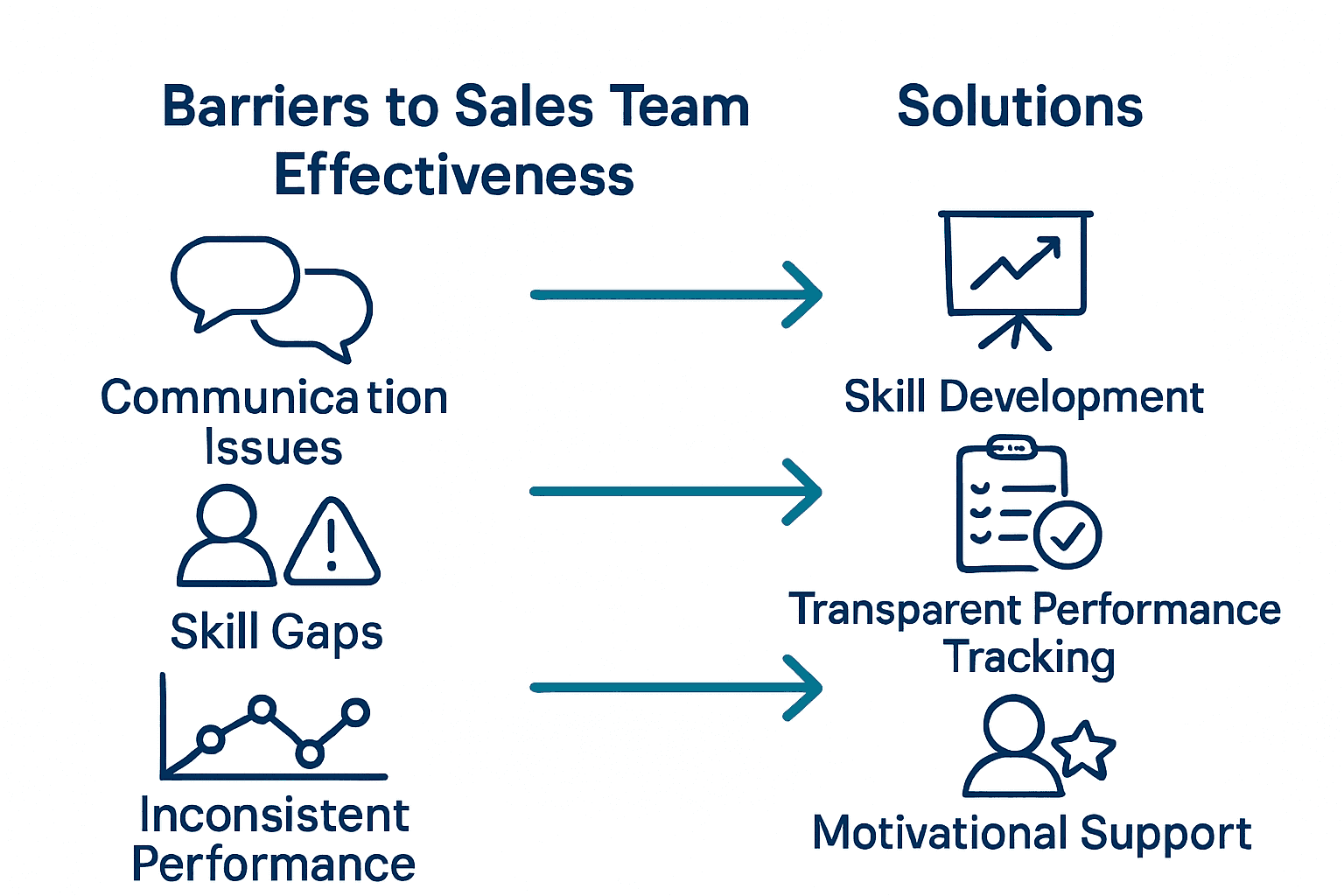
Common barriers to sales team effectiveness include:
- Communication Breakdowns
- Inconsistent Performance
- Skill Gaps
- Motivational Challenges
- Limited Performance Visibility
Objection Handling: Everything You Need to Know provides critical insights into addressing performance obstacles. Sales Assessment Testing recommends combining qualitative and quantitative metrics to mitigate challenges like performance anxiety and create a more transparent, supportive evaluation environment.
Overcoming these barriers requires a holistic approach that balances individual support with team-wide strategic development. Sales leaders must create adaptive frameworks that recognize unique team dynamics, provide targeted skill development, and foster a culture of continuous improvement and mutual accountability. This means moving beyond traditional performance management to develop more empathetic, data-driven strategies that empower each team member to reach their full potential.
Transform Your Sales Team Effectiveness Today
Struggling to align your sales team around shared goals and overcome communication breakdowns that hold back consistent growth? This article highlights the vital role of interdependence, continuous learning, and teamwork dynamics in driving sales success. If your business is aiming for at least 50% sales growth and wants to ensure every quarter meets its targets, then strategic, personalised coaching combined with proven training methods is essential.
Discover bespoke 1:1 coaching and consultancy designed for businesses with growth mindsets at Ahead of Sales. Our packages focus on improving sales team effectiveness through continuous skills development and adaptive problem-solving strategies outlined in the article. Don’t wait for inconsistent performance or skill gaps to limit your team’s potential. Take the next step and explore how we can help you build a high-performing sales team that thrives on collaboration and hits its targets every time. Visit us now at Ahead of Sales to start your transformation journey.
Frequently Asked Questions
What is sales team effectiveness?
Sales team effectiveness refers to a strategic approach that evaluates a team’s ability to meet collective sales goals through collaborative efforts, emphasizing interdependence among team members.
What are the key metrics for measuring sales team effectiveness?
Key metrics include revenue-driven metrics (total sales volume, conversion rates), customer-centric metrics (Net Promoter Score, customer retention), operational performance metrics (sales activity tracking, pipeline velocity), and qualitative assessments (team cohesion, collaboration).
What factors contribute to high-performing sales teams?
High-performing sales teams are driven by effective communication, shared goal alignment, continuous learning culture, interpersonal skill development, and adaptive problem-solving capabilities.
How can sales teams improve their effectiveness?
Sales teams can improve effectiveness through continuous skills development, implementing technology-enhanced learning solutions, and creating a culture of ongoing training and strategic adjustments tailored to individual team members’ strengths.
Recommended
- Sales Team Performance Explained: Maximizing Growth Results – Ahead of Sales
- 7 Impactful Examples of Sales Coaching for Business Growth – Ahead of Sales
- 7 Essential Sales Team Training Topics for Growth – Ahead of Sales
- The Essential Guide to the Role of Sales Management – Ahead of Sales
- Estrategias de motivación personal para equipos de marketing 2025