
Most advice about feedback in sales coaching overlooks the subtle impact of cultural context, yet research shows that over 80 percent of British sales teams prefer structured feedback routines for better performance. That matters because the approach to coaching feedback can shape trust, drive results, and keep motivation high. By digging into the foundations of feedback in sales coaching, you will discover practical methods and proven strategies suited to British teams and sales leaders.
Table of Contents
- Defining Feedback In Sales Coaching
- Types Of Feedback Used In Sales Coaching
- How Effective Feedback Drives Sales Performance
- Integrating Feedback Into Coaching Programmes
- Common Pitfalls And Misconceptions About Feedback
Key Takeaways
| Point | Details |
|---|---|
| Feedback is a Collaborative Process | Effective feedback should be framed as a partnership aimed at mutual improvement, fostering a safe environment for growth. |
| Diverse Feedback Types are Essential | Employ a mix of informal, formal, and 360-degree feedback to provide comprehensive insights and track performance effectively. |
| Constructive Communication Encourages Growth | Utilize supportive communication that connects constructive criticism to clear developmental goals, enhancing motivation and performance. |
| Integration of Feedback is Key | Establish structured feedback mechanisms that normalise open dialogue, merging quantitative metrics with qualitative insights for holistic development. |
Defining Feedback in Sales Coaching
Sales coaching feedback represents a strategic communication process designed to enhance individual and team performance through targeted guidance and constructive dialogue. Robust feedback mechanisms are essential educational tools that transform raw performance data into actionable insights for professional development.
At its core, feedback in sales coaching involves a systematic approach of providing specific, timely information about an individual’s performance, highlighting strengths and identifying precise areas requiring improvement. The British School of Coaching emphasises that feedback serves multiple critical functions, including relationship building, performance enhancement, and driving sustained behavioural change.
Effective sales coaching feedback operates through several key dimensions:
- Timeliness of information delivery
- Specificity of performance insights
- Constructive and supportive communication style
- Clear connection between current performance and desired outcomes
- Measurable performance improvement targets
Pro Tip – Feedback Mastery: Always frame feedback as a collaborative improvement journey, not a critical evaluation, to maintain psychological safety and encourage genuine performance growth.
Successful sales organisations understand that feedback is not a one-way monologue but a dynamic, interactive process that requires mutual respect, active listening, and a genuine commitment to individual and collective advancement.
Types of Feedback Used in Sales Coaching
Sales coaching incorporates multiple feedback mechanisms designed to provide comprehensive performance insights. Feedback types range from informal interactions to structured evaluations, each serving unique developmental purposes within the sales environment.
Three primary categories of feedback dominate modern sales coaching practices:
- Informal Feedback: Spontaneous, real-time guidance provided during daily interactions
- Formal Performance Appraisals: Structured assessments conducted at predetermined intervals
- 360-Degree Feedback: Comprehensive evaluations gathering insights from multiple perspectives including peers, managers, and self-assessment
Informal feedback represents the most immediate form of performance guidance, allowing sales managers to provide instant corrections and acknowledgements. These quick, contextual interactions help teams make rapid adjustments and maintain momentum. Formal performance appraisals, by contrast, offer systematic reviews that track long-term progression, analyse comprehensive performance metrics, and establish clear developmental trajectories.
The 360-degree feedback model introduces a holistic approach by collecting input from multiple stakeholders. This method provides a nuanced understanding of an individual’s performance, revealing blind spots and offering a more balanced perspective than traditional top-down evaluation techniques.
1:1 sales coaching techniques play a critical role in translating these feedback mechanisms into actionable development strategies, ensuring that insights lead to meaningful performance improvements.
Pro Tip – Feedback Navigation: Design a balanced feedback approach that combines real-time informal guidance with structured periodic reviews to maintain continuous professional development and team motivation.
Successful sales organisations recognise that effective feedback is not a one-size-fits-all process but a nuanced, adaptive strategy tailored to individual learning styles and organisational goals.
The following table compares common feedback methods in sales coaching and their unique business impacts:
| Feedback Method | Typical Use Case | Impact on Team Performance |
|---|---|---|
| Informal Feedback | Real-time guidance during daily tasks | Quick course-correction and engagement |
| Formal Appraisal | Scheduled, metrics-driven reviews | Tracks development and goal progress |
| 360-Degree Evaluation | Multi-source performance assessment | Reveals hidden strengths and weaknesses |
| 1:1 Coaching Sessions | Individualised skill development | Maximises personal growth trajectory |
How Effective Feedback Drives Sales Performance
Positive motivational feedback strategies have a transformative impact on sales team performance, creating a powerful mechanism for continuous improvement and professional growth. Research demonstrates that strategic feedback approaches can significantly elevate individual and collective sales capabilities.
The mechanics of effective feedback in sales performance centre around several critical dimensions:
- Timely and specific performance insights
- Constructive and encouraging communication
- Clear connection between feedback and developmental objectives
- Measurable performance tracking
- Personalised improvement strategies
Thoughtful and intentional feedback mechanisms promote learning environments where sales professionals can understand their strengths and systematically address performance gaps. This approach transforms feedback from a passive assessment into an active developmental tool.

Understanding the nuanced psychology of feedback is crucial. While positive reinforcement significantly boosts motivation and subsequent performance, negative feedback requires careful, strategic delivery to prevent demotivation. Sales performance improvement strategies must balance constructive critique with motivational support.
Pro Tip – Feedback Precision: Design feedback conversations as collaborative dialogues, not unilateral critiques, ensuring sales professionals feel supported and empowered to enhance their performance.
Successful sales organisations recognise that effective feedback is a sophisticated, dynamic process requiring emotional intelligence, strategic communication, and a genuine commitment to individual and collective professional development.
Integrating Feedback into Coaching Programmes
Skillful feedback delivery represents a sophisticated approach to transforming coaching programmes, enabling organisations to create robust developmental pathways for their sales professionals. The integration process requires strategic planning, emotional intelligence, and a systematic methodology.
Effective feedback integration involves several critical components:
- Establishing clear performance expectations
- Creating structured feedback channels
- Developing personalised developmental frameworks
- Implementing consistent evaluation mechanisms
- Ensuring psychological safety during feedback interactions
The foundational element of integrating feedback lies in developing a transparent communication infrastructure. Sales coaches must design programmes that normalise feedback as a continuous, supportive dialogue rather than an occasional, potentially threatening evaluation. This approach transforms feedback from a potentially confrontational experience into a collaborative growth opportunity.
Effective sales training methods demonstrate that successful feedback integration requires a multifaceted approach. Coaches need to balance quantitative performance metrics with qualitative insights, creating a holistic understanding of individual and team capabilities.
Pro Tip – Feedback Architecture: Develop a feedback ecosystem that treats every interaction as a learning opportunity, not a judgement, by establishing clear expectations and maintaining consistent, supportive communication channels.
Successful coaching programmes recognise that feedback integration is not a static process but a dynamic, evolving strategy that adapts to changing organisational needs and individual developmental trajectories.
Common Pitfalls and Misconceptions About Feedback
Sales coaching feedback is often misunderstood, with several prevalent misconceptions that can significantly undermine its effectiveness. The traditional ‘compliment sandwich’ approach, which involves embedding criticism between two layers of praise, represents one of the most common yet counterproductive feedback strategies.
Key misconceptions about feedback in sales coaching include:
- Believing negative feedback is inherently demotivating
- Assuming all feedback must be balanced equally
- Treating feedback as a purely evaluative rather than developmental process
- Overlooking the importance of specificity in feedback delivery
- Failing to distinguish between feedback and coaching objectives
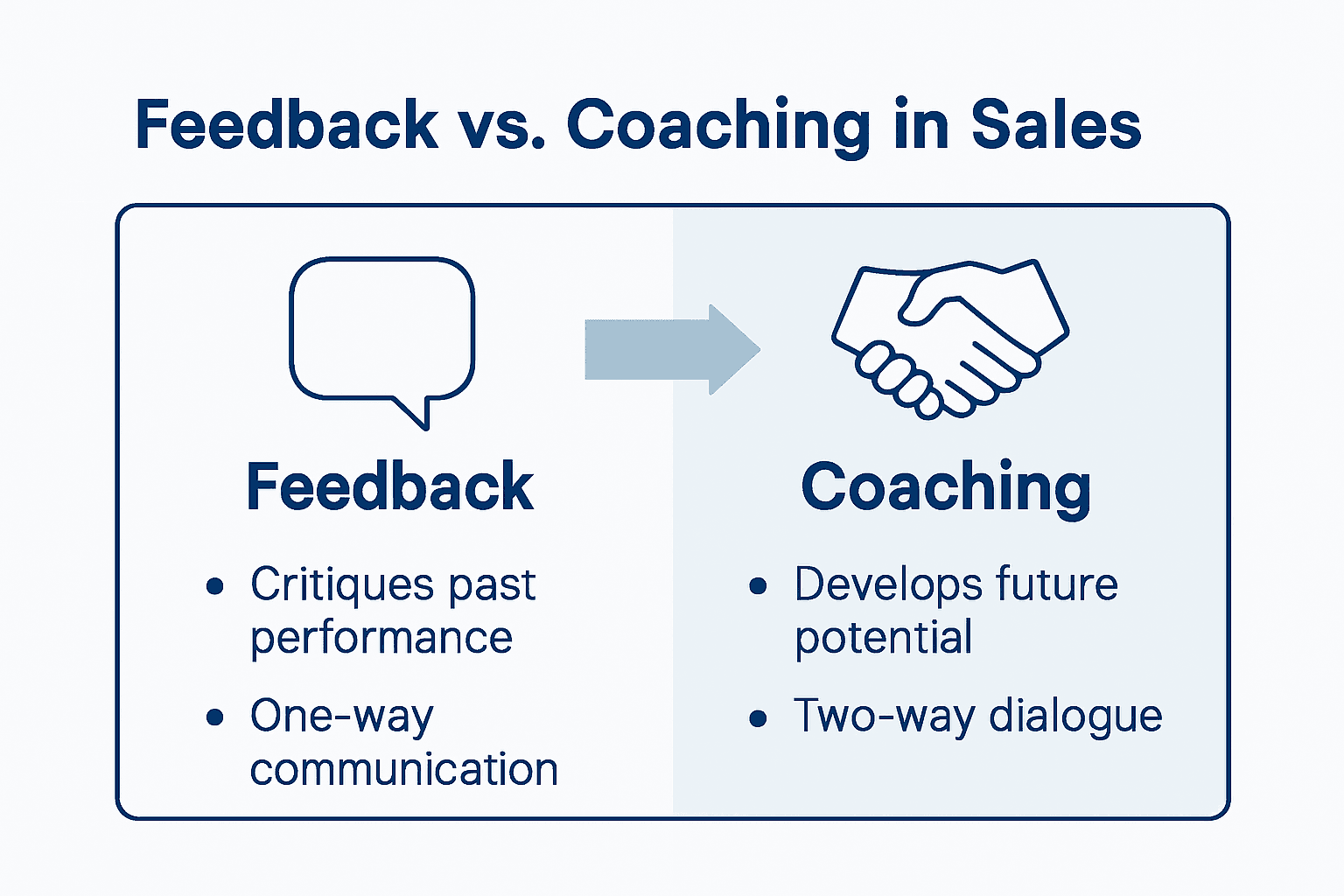
Distinguishing between sales coaching and feedback requires understanding their unique purposes. Feedback primarily focuses on performance correction, while coaching emphasises strength development and potential realisation. This nuanced difference is crucial for creating effective developmental strategies.
The table below highlights key differences between feedback and coaching in the sales context:
| Aspect | Feedback | Coaching |
|---|---|---|
| Primary Objective | Addressing specific performance | Unlocking potential and strengths |
| Nature | Often short-term, corrective | Long-term, developmental |
| Communication Style | Direct and targeted | Conversational and exploratory |
| Focus | Bridging gaps, providing clarity | Facilitating growth and insight |
Many organisations mistakenly view feedback as a punitive mechanism rather than a collaborative growth opportunity. Successful sales teams recognise feedback as a sophisticated communication tool that requires emotional intelligence, strategic thinking, and a genuine commitment to individual professional advancement.
Pro Tip – Feedback Transformation: Reframe feedback conversations as partnership discussions, where the primary goal is mutual understanding and collaborative performance improvement, not judgement or criticism.
Ultimately, effective feedback transcends simple praise or critique, representing a complex, nuanced dialogue that requires empathy, precision, and a forward-looking perspective.
Unlock Sales Growth Through Expert Feedback and Coaching
Struggling to turn feedback into measurable sales growth The article highlights how precise, timely, and motivational feedback is key to boosting sales team performance and driving continuous improvement. If you find your current sales coaching efforts do not translate into real growth or your team needs personalised support to hit ambitious targets, you are facing a challenge many businesses share.
We focus on blending tailored 1:1 coaching with proven strategies that make feedback not just a task but a growth engine. Our approach emphasises collaboration, emotional intelligence, and clear development pathways that overcome common pitfalls like ineffective feedback methods and low motivation.
Explore proven methods and strategic insights in our Sales Strategy Archives – Ahead of Sales to see how structured feedback integration transforms sales teams.

Ready to convert feedback into at least 50 percent sales growth every year Discover how our bespoke coaching and comprehensive training packages create empowered sales teams that consistently hit their targets. Start your journey to sustained sales performance now at Ahead of Sales and learn more about effective methods in our Sales Playbook Archives – Ahead of Sales. Take the next step towards transforming your sales culture with expert support today.
Frequently Asked Questions
What is the role of feedback in sales coaching?
Feedback in sales coaching is a strategic communication process aimed at enhancing individual and team performance by providing specific, timely information about performance strengths and areas for improvement.
What are the different types of feedback used in sales coaching?
Sales coaching typically incorporates three primary types of feedback: informal feedback (real-time guidance), formal performance appraisals (structured evaluations), and 360-degree feedback (multi-source assessments).
How does effective feedback drive sales performance?
Effective feedback enhances sales performance by providing timely and specific insights, fostering constructive communication, tracking measurable performance, and connecting feedback to personal developmental objectives.
What are common misconceptions about feedback in sales coaching?
Common misconceptions include the belief that negative feedback is always demotivating, that all feedback should be balanced equally, and that feedback is purely evaluative rather than developmental.
Recommended
- 7 Impactful Examples of Sales Coaching for Business Growth – Ahead of Sales
- Sales Training Matters: Complete Guide for Growth – Ahead of Sales
- 7 Essential Sales Leadership Tips for Fast Growth – Ahead of Sales
- 7 Proven Sales Acceleration Strategies for Rapid Growth – Ahead of Sales
- Local Lead Generation Explained: Driving Booked Jobs
- Understanding the Importance of Customer Communication – My WordPress