
Over 60 percent of British sales teams report better customer retention when they use a value selling strategy. Businesses across the United Kingdom are shifting focus from transactional sales to building lasting value for clients, ensuring every solution is tied directly to measurable outcomes. Understanding the core principles of value selling helps sales professionals deliver results that resonate with the unique needs and business goals of British companies.
Table of Contents
- Core Principles Of Value Selling
- Types Of Value Selling And Applications
- The Value Selling Process Explained
- Benefits For Teams And Organisations
- Common Pitfalls In Value Selling Strategies
Key Takeaways
| Point | Details |
|---|---|
| Customer-Centric Approach | Value selling emphasises understanding customer challenges and aligning solutions with their strategic objectives. |
| Economic Impact Measurement | Sales professionals should quantify the economic benefits and articulate clear business cases for their solutions. |
| Strategic Relationship Building | Transition from transactional selling to long-term partnerships enhances customer loyalty and trust. |
| Ongoing Skills Development | Implement training programmes to equip sales teams with essential diagnostic and consultative skills for sustained effectiveness. |
Core Principles Of Value Selling
Value selling represents a strategic approach to sales that transcends traditional transactional methods, focusing instead on delivering measurable business outcomes for customers. At its core, value selling prioritises understanding the customer’s unique challenges and demonstrating how a solution directly addresses their specific strategic objectives.
The fundamental principles of value selling emerge from a customer-centric service framework where value is co-created between providers and customers. This means sales professionals must shift from merely presenting product features to articulating precise economic and strategic benefits. Successful value selling requires deep business acumen, enabling sales teams to map their solutions directly to a client’s critical performance indicators and anticipated return on investment.
Key principles of effective value selling include:
- Conducting comprehensive customer diagnostics to understand underlying business challenges
- Quantifying potential value through measurable, data-driven outcomes
- Developing consultative communication strategies
- Aligning proposed solutions precisely with customer strategic goals
- Demonstrating clear, tangible economic impact beyond surface-level product capabilities
Pro Tip for Value Selling Success: Develop a systematic approach to documenting and presenting your value proposition, creating customised economic impact models for each potential client that clearly illustrate how your solution translates into measurable financial benefits.
Types Of Value Selling And Applications
Value selling encompasses multiple strategic approaches designed to demonstrate tangible economic benefits to potential customers. These approaches differ based on industry context, customer complexity, and specific business objectives, requiring sales professionals to adapt their methodologies dynamically.
One prominent approach is consultative value selling, which involves detailed strategic analysis of market innovation processes. This method focuses on deeply understanding customer challenges and aligning solutions with their specific strategic goals. Sales teams utilise comprehensive diagnostic techniques to map precise value propositions that go beyond traditional product presentations.
The primary types of value selling include:
- Solution-based value selling: Tailoring comprehensive solutions to specific customer problems
- Economic value selling: Quantifying financial benefits and return on investment
- Consultative value selling: Engaging in strategic dialogue to co-create value
- Outcome-based value selling: Focusing on measurable business results
- Relationship-driven value selling: Building long-term partnerships based on demonstrated value
Pro Tip for Strategic Value Mapping: Develop a standardised value assessment framework that allows you to systematically quantify and communicate potential economic impacts across different customer segments, enabling more precise and compelling value narratives.
The following table compares the main types of value selling and their ideal business applications:
| Value Selling Type | Distinctive Focus | Common Use Cases |
|---|---|---|
| Solution-based | Tailoring solutions to problems | Complex B2B sales, technical products |
| Economic value | Quantifying ROI and savings | Financial services, procurement deals |
| Consultative | Co-creating strategic value | Enterprise partnerships, long cycles |
| Outcome-based | Measurable business results | Performance contracts, managed services |
| Relationship-driven | Building long-term trust | Account management, customer success |
The Value Selling Process Explained
The value selling process represents a sophisticated, strategic approach to sales that transcends traditional transactional methods. At its core, this methodology requires sales professionals to transform from product pushers to strategic business partners who deeply understand and address customer challenges.
Successful value selling follows a structured process of collaborative value co-creation, which involves several critical stages of engagement. These stages are designed to systematically uncover, quantify, and communicate the precise economic and strategic benefits a solution can deliver to the customer.
Key stages of the value selling process include:
- Discovery Phase: Conducting comprehensive diagnostics to understand the customer’s unique business context
- Needs Assessment: Mapping underlying challenges and strategic objectives
- Value Quantification: Developing measurable economic impact models
- Solution Design: Crafting tailored solutions precisely aligned with identified challenges
- Economic Justification: Presenting a clear, data-driven business case
- Collaborative Implementation: Working jointly to ensure value realisation
Pro Tip for Process Mastery: Create a standardised value selling playbook that guides your team through each stage, incorporating detailed questioning frameworks, value calculation templates, and strategic alignment checklists to ensure consistent and impactful customer interactions.
Benefits For Teams And Organisations
Value selling represents a transformative approach that delivers substantial benefits beyond traditional sales methodologies, fundamentally reshaping how organisations approach customer relationships and revenue generation. By shifting from transactional interactions to strategic partnerships, businesses can unlock significant competitive advantages that permeate entire organisational ecosystems.

Research demonstrates that strategic value creation directly influences firm sales performance, with profound implications for team effectiveness and organisational growth. This approach enables sales teams to move beyond mere product pushing, positioning them as trusted advisors who provide genuine business solutions tailored to specific customer challenges.
Key benefits for teams and organisations include:
- Enhanced customer relationship quality
- Improved sales team credibility and professional standing
- More predictable and sustainable revenue streams
- Deeper understanding of customer strategic objectives
- Higher customer retention and loyalty rates
- Increased sales team motivation and strategic thinking
- Better alignment between sales efforts and business outcomes
Pro Tip for Organisational Transformation: Develop a comprehensive value selling training programme that equips your sales team with diagnostic skills, economic modelling techniques, and consultative communication strategies, ensuring they can consistently deliver measurable value to potential customers.
This table outlines how value selling impacts various aspects of organisational performance:
| Area Improved | Impact of Value Selling | Long-term Benefit |
|---|---|---|
| Customer Relationships | Moves to partnership approach | Stronger loyalty, repeat business |
| Sales Team Credibility | Shifts focus to business outcomes | Elevated professional reputation |
| Revenue Generation | Prioritises recurring value | Greater predictability |
| Team Motivation | Encourages strategic thinking | Higher engagement, lower turnover |
Common Pitfalls In Value Selling Strategies
Value selling demands a sophisticated approach, yet many organisations inadvertently undermine their potential by falling into predictable strategic traps that compromise their sales effectiveness. Understanding these common pitfalls is crucial for developing a robust and sustainable value selling methodology that genuinely delivers results.
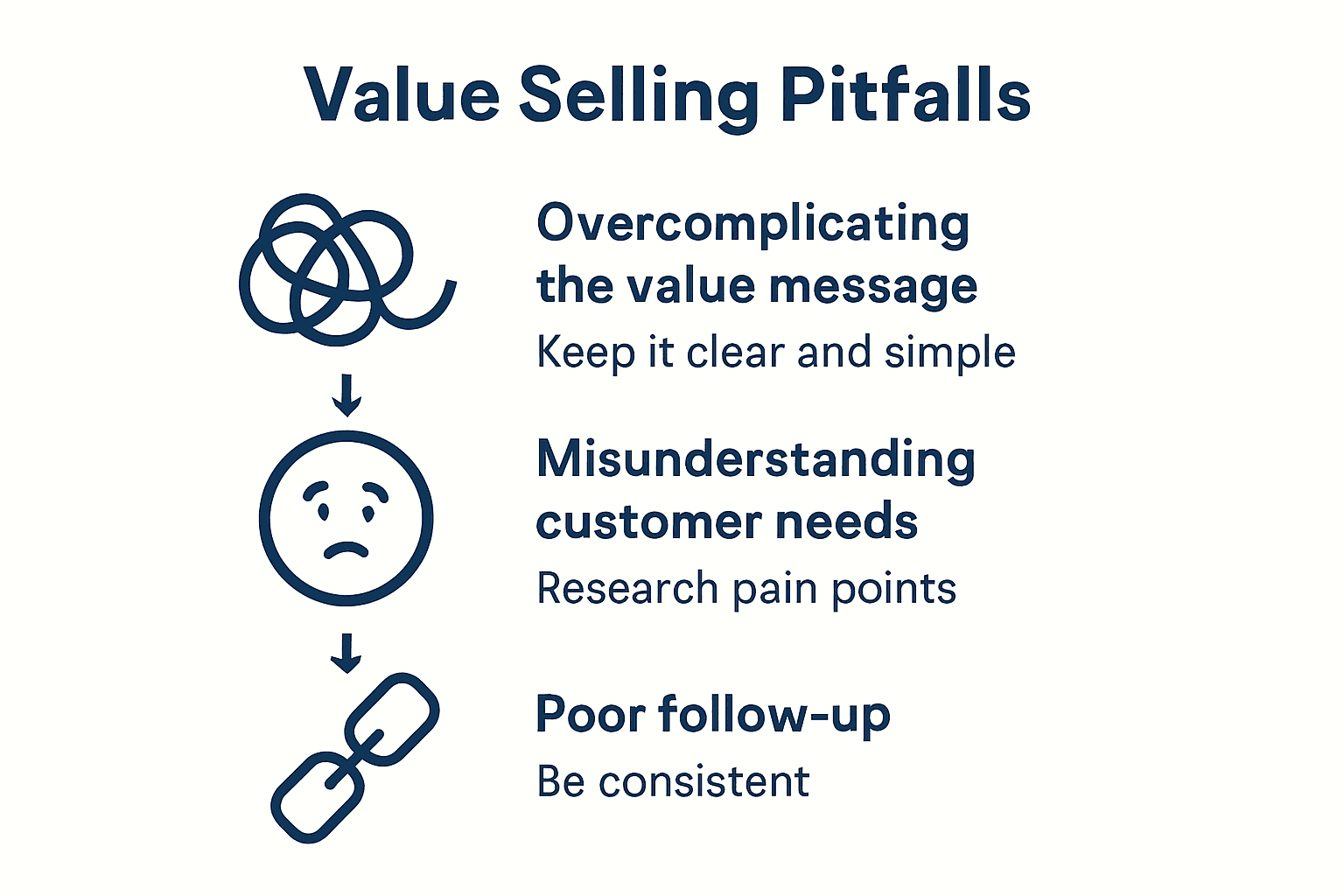
Research highlights that aggressive sales tactics can significantly damage customer relationships, undermining the core principles of value selling. Sales teams often make critical mistakes by prioritising short-term transaction metrics over long-term relationship building, which fundamentally contradicts the strategic intent of value-based approaches.
Common pitfalls in value selling strategies include:
- Overcomplicating the value proposition
- Failing to thoroughly understand customer business contexts
- Relying on generic product features instead of specific outcomes
- Neglecting to quantify economic impact
- Using pushy, transactional communication styles
- Insufficient preparation and customer research
- Inconsistent value delivery across sales interactions
- Lack of ongoing value measurement and communication
Pro Tip for Strategic Avoidance: Implement a rigorous pre-sales diagnostic process that systematically maps customer challenges, validates potential economic impact, and develops tailored value narratives before any sales engagement, ensuring your approach remains genuinely customer-centric.
Unlock Sustainable Sales Growth Through Value Selling
If you feel your sales team is struggling to connect your product benefits to real customer outcomes then the principles outlined in “Value Selling: Driving Sustainable Sales Growth” can transform your approach. This article highlights how understanding customer challenges and quantifying economic value are crucial to shifting from transactional selling to strategic partnership. Our bespoke 1:1 coaching combined with traditional training at Ahead Of Sales empowers your sales team to consistently identify and communicate measurable value that drives repeat business and boosts confidence.
Take the step to leave behind pushy sales tactics and generic pitches opting for a proven strategy that delivers at least 50 per cent sales growth. Explore our tailored sales training solutions designed for businesses with growth mindsets and teams ready to hit every target quarter. Don’t wait for another missed opportunity: harness consultative techniques and value quantification now at Ahead Of Sales and turn strategic selling into your competitive advantage.
Frequently Asked Questions
What is value selling?
Value selling is a strategic approach to sales that focuses on delivering measurable business outcomes for customers. It involves understanding customer challenges and demonstrating how a solution addresses their specific strategic objectives.
How can I effectively implement value selling in my sales team?
To implement value selling effectively, develop a systematic approach that includes comprehensive customer diagnostics, quantifying potential value with data-driven outcomes, and aligning proposed solutions with the customer’s strategic goals.
What are some common pitfalls to avoid in value selling?
Common pitfalls in value selling include overcomplicating the value proposition, failing to understand customer business contexts, relying on generic product features, and neglecting to quantify the economic impact of your solutions.
What are the benefits of adopting a value selling approach for organisations?
Adopting a value selling approach enhances customer relationships, improves sales team credibility, creates predictable revenue streams, increases customer retention, and promotes higher engagement and motivation within the sales team.