
Did you know that companies with a clearly defined sales team structure can achieve up to 15 percent higher revenue growth? How you organize your sales team influences not just daily routines but also long-term business success. By understanding how structure and specialized roles work together, you set the stage for teamwork, consistent performance, and smarter decision-making in a fast-changing market.
Table of Contents
- Defining Sales Team Structure And Purpose
- Core Roles Within Modern Sales Teams
- Common Models: Inside, Field, Hybrid, Pod
- Scaling And Adapting Your Sales Structure
- Mistakes To Avoid In Sales Team Design
Key Takeaways
| Point | Details |
|---|---|
| Sales Team Structure | A well-defined sales team structure enhances organizational effectiveness and revenue generation by aligning roles, responsibilities, and performance measurement. |
| Core Sales Roles | Understanding specialized roles, such as SDRs and Client Success Associates, is crucial for optimizing sales processes and driving revenue. |
| Sales Models | Choosing the appropriate sales model—Inside, Field, Hybrid, or Pod—should align with market demands and team capabilities for effective revenue generation. |
| Avoiding Common Mistakes | Organizations should avoid pitfalls such as misaligned incentive structures and inefficient communication channels to maintain a high-performing sales team. |
Defining Sales Team Structure And Purpose
A sales team structure represents the strategic blueprint that transforms individual talent into a cohesive revenue-generating machine. According to ifheindia, a sales organization is fundamentally designed to achieve company objectives, streamline reporting relationships, and develop an efficient sales force capable of executing effective selling strategies.
Designing a sales organization requires careful consideration of multiple interconnected factors. salesmanagement.org highlights that successful sales team structures balance external market dynamics with internal capabilities. This means understanding your target markets, technological landscape, company objectives, and the optimal size and composition of your sales workforce.
Key components of an effective sales team structure typically include:
- Clear reporting hierarchies
- Well-defined roles and responsibilities
- Aligned compensation and incentive models
- Integrated communication channels
- Scalable performance measurement systems
The ultimate purpose of a robust sales team structure transcends mere organizational charts. It creates a framework that enables consistent performance, drives strategic alignment, and empowers individual sales professionals to contribute meaningfully to overarching business goals. By meticulously designing your sales team’s architecture, you transform a group of individual sellers into a synchronized, high-performing revenue generation engine.
Core Roles Within Modern Sales Teams
Understanding the core roles within contemporary sales teams is critical for building a high-performance revenue generation engine. According to career.virginia.edu, modern sales organizations comprise a diverse array of specialized roles designed to streamline the sales process and maximize revenue potential. These roles range from Sales Development Representatives (SDRs) and Business Development Representatives (BDRs) to more nuanced positions like Sales Operations Analysts and Client Success Associates.
forimpact.org introduces an innovative perspective through the Team Selling Framework, which categorizes sales roles into strategic teams with distinct responsibilities. This framework segments sales professionals into:
- Green Team: Core sales strategists responsible for overall strategy and deal closure
- Red Team: Support personnel managing visit preparations and follow-up processes
- Blue Team: Context providers who bring credibility and strategic connections
Beyond these categorizations, contemporary sales teams typically require professionals who can navigate complex sales landscapes. Key roles often include:
- Sales Development Representatives (SDRs): Initial prospect engagement specialists
- Account Executives: Relationship managers driving deal negotiations
- Sales Operations Analysts: Performance optimization and strategic planning experts
- Client Success Associates: Post-sale relationship management and retention specialists
The modern sales team is no longer a monolithic group of generalist sellers. Instead, it’s a sophisticated ecosystem of specialized roles working in concert to drive revenue, build relationships, and create sustainable growth strategies. By understanding and strategically designing these roles, businesses can create more agile, responsive, and effective sales organizations.

Common Models: Inside, Field, Hybrid, Pod
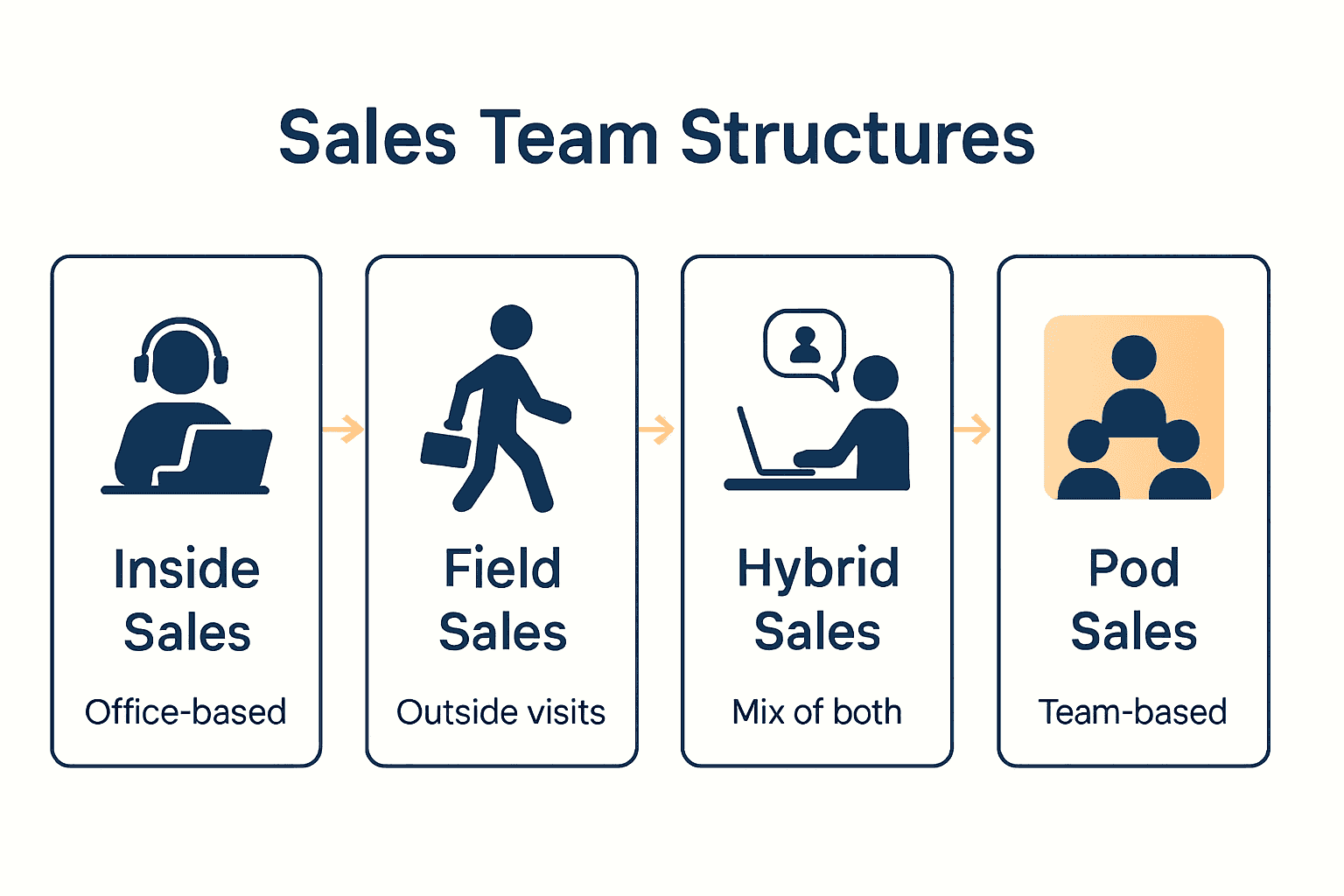
Navigating the landscape of sales team structures requires understanding the fundamental models that organizations deploy to maximize their revenue potential. According to salesmanagement.org, contemporary businesses typically employ four primary sales organization designs: Inside Sales, Field Sales, Hybrid, and Pod structures, each offering unique advantages for different business contexts.
aimuniversitygroup.org expands on this framework by highlighting additional organizational approaches, demonstrating that sales structures can be strategically designed around various parameters such as geography, product lines, customer segments, and functional specializations. This flexibility allows businesses to create tailored sales ecosystems that align with their specific market demands and operational strengths.
Let’s break down the key characteristics of these sales models:
Here’s a comparison of the four primary sales team structure models:
| Sales Model | Key Characteristics | Optimal For |
|---|---|---|
| Inside Sales | Remote selling Digital channels |
High volume, low complexity sales |
| Field Sales | Face-to-face On-site presentations |
Complex, relationship-driven selling |
| Hybrid Sales | Combines remote & in-person | Broad market reach, mixed sales needs |
| Pod Sales | Cross-functional integrated teams | Agile, collaborative environments |
- Inside Sales: Fully remote sales conducted via phone, email, and digital communication channels
- Field Sales: Traditional face-to-face selling, involving direct client interactions and on-site presentations
- Hybrid Sales: Combining remote and in-person sales strategies for maximum reach and flexibility
- Pod Sales: Cross-functional teams with integrated roles working collaboratively towards shared revenue goals
Choosing the right sales model isn’t about finding a universal solution, but rather identifying the approach that best matches your business’s unique sales ecosystem. Factors like product complexity, target market, customer acquisition costs, and team capabilities will ultimately determine which structure will drive your organization’s most effective revenue generation strategy.
 The most successful companies continuously evaluate and adapt their sales models to maintain competitive advantage in an ever-evolving business landscape.
Scaling And Adapting Your Sales Structure
Scaling a sales organization is a complex, strategic endeavor that demands careful planning and continuous evolution. According to hbs.edu, building the first sales team requires a deep understanding of go-to-market functions and meticulous management of sales processes within entrepreneurial environments. This initial phase is critical, as the foundation you establish will determine your team’s future growth potential and adaptability.
online1.gsb.columbia.edu emphasizes that successful sales structure adaptation hinges on designing an empowered, high-performance team with a focus on agility and motivation. This approach transcends traditional hierarchical models, instead creating a dynamic ecosystem that can rapidly respond to market changes and emerging opportunities.
Key strategies for scaling and adapting your sales structure include:
- Modular Team Design: Create flexible team structures that can be quickly reconfigured
- Continuous Skills Development: Invest in ongoing training and upskilling
- Performance-Driven Compensation: Implement adaptive reward systems
- Technology Integration: Leverage CRM and sales enablement tools
- Regular Performance Audits: Conduct frequent reviews of team effectiveness
Successful scaling is not about simply adding more people, but about creating an intelligent, responsive sales machine. This means developing a culture of continuous learning, maintaining clear communication channels, and being willing to experiment with different organizational approaches. Your sales structure should be a living, breathing entity that grows and adapts alongside your business, always aligned with your strategic objectives and market dynamics.
Mistakes To Avoid In Sales Team Design
Building an effective sales team structure requires strategic foresight and meticulous planning. According to wmep.org, organizations frequently stumble by committing critical errors that undermine their sales potential. These fundamental mistakes include lacking robust sales pipeline forecasting tools, improperly staffing teams, failing to define clear sales metrics, and neglecting to establish a structured sales process.
ifheindia.org emphasizes that a sales organization must fundamentally aid corporate objectives while developing specialized selling functions. This means creating an integrated ecosystem where sales personnel are not just individual contributors, but strategic assets aligned with broader business goals.
Key mistakes to vigilantly avoid include:
- Misaligned Compensation Plans: Creating incentive structures that don’t genuinely motivate performance
- Lack of Defined Metrics: Operating without clear, measurable performance indicators
- Poor Communication Channels: Failing to establish seamless interdepartmental collaboration
- Rigid Organizational Structures: Designing inflexible teams unable to adapt to market changes
- Inadequate Training Programs: Neglecting continuous skills development and professional growth
Successful sales team design is not about avoiding all mistakes, but about creating a resilient, adaptive framework that can quickly identify and correct potential issues. The most effective sales organizations treat their team structure as a living, breathing entity that requires constant nurturing, strategic recalibration, and a commitment to continuous improvement. By proactively addressing potential pitfalls and maintaining an agile approach, businesses can develop sales teams that are not just functional, but truly exceptional.
Unlock Your Sales Team’s Full Potential with Bespoke Coaching
Understanding the complexities of sales team structure and roles is only the first step to truly energising your revenue growth. Many businesses struggle with crafting agile, well-defined sales teams that stay motivated and aligned with company goals. If you recognise the challenges of scaling your sales organisation or designing specialised roles like Sales Development Representatives or Sales Operations Analysts, you are not alone. These issues can prevent consistent performance and stall your progress towards hitting quarterly targets.
At Ahead of Sales, we specialise in transforming sales teams into high-performing revenue engines through customised 1:1 coaching, traditional training, and consultancy. Our programmes are tailored for businesses with 50 to 1000 employees who strive for at least 50% annual sales growth. Whether you need help refining your team structure, developing effective incentive schemes, or implementing scalable sales processes, our expert guidance will help you overcome common pitfalls and unlock agile, effective sales strategies.

Take the first step to build a sales organisation that adapts, performs, and thrives. Explore how our comprehensive support can accelerate your sales team success by visiting Ahead of Sales. Discover the proven methods to design winning sales teams that consistently hit their targets and power your business growth. Don’t wait to turn your sales challenges into a competitive advantage.
Frequently Asked Questions
What is the purpose of a sales team structure?
A sales team structure is designed to achieve company objectives, streamline reporting relationships, and develop an efficient sales force capable of executing effective selling strategies.
What are the core roles within modern sales teams?
Modern sales teams comprise various specialized roles, including Sales Development Representatives (SDRs), Account Executives, Sales Operations Analysts, and Client Success Associates, each focused on different aspects of the sales process.
What are the common types of sales team structures?
The four primary types of sales team structures are Inside Sales, Field Sales, Hybrid Sales, and Pod Sales, each with distinct characteristics and optimal use cases depending on the business context.
How can organizations effectively scale their sales structure?
Organizations can effectively scale their sales structure by designing modular team setups, investing in continuous skills development, implementing performance-driven compensation strategies, integrating technology, and conducting regular performance audits.