
Every UK sales director knows the challenge of balancing growth targets with consistent team results. Sales development is a structured approach that turns chaotic prospecting into focused business expansion, especially in competitive sectors like technology and services. Today, staying ahead means aligning your selling strategy with shifting buyer expectations, ensuring your team engages the right prospects and adapts methods for maximum impact in the British market.
Table of Contents
- Defining Sales Development And Core Concepts
- Types Of Sales Development Representatives
- The Sales Development Process In Practice
- Essential Skills And Technologies For Success
- Risks, Costs, And Common Mistakes To Avoid
Key Takeaways
| Point | Details |
|---|---|
| Understanding Sales Development | Sales development is a structured approach to engaging potential business opportunities and requires adapting to customer needs. |
| Importance of Skills and Technology | Emotional intelligence and digital literacy are essential for modern sales professionals to drive success. |
| Risks and Mistakes | Common pitfalls such as resource misallocation and inadequate lead qualification can significantly hinder sales performance. |
| Continuous Improvement | Regularly refining sales strategies and training can optimise processes and enhance team effectiveness. |
Defining sales development and core concepts
Sales development represents a strategic approach to systematically identifying, engaging, and qualifying potential business opportunities within an organisation’s sales ecosystem. At its core, this discipline involves adapting selling approaches to diverse buying situations and customer needs.
The fundamental components of sales development encompass several critical elements:
- Prospecting: Identifying potential customers and business opportunities
- Lead Qualification: Assessing potential clients’ readiness and fit for your products
- Relationship Building: Establishing trust and understanding customer organisational dynamics
- Sales Methodology Alignment: Matching sales strategies to specific industry contexts
Effective sales development goes beyond traditional selling techniques by creating a structured framework for revenue generation. It requires sales professionals to understand complex organisational landscapes, manage intricate deals, and continuously adapt their approaches to changing market conditions.

At the strategic level, sales development integrates multiple disciplines, including:
Here is a comparison of the strategic disciplines involved in sales development and their organisational impact:
| Discipline | Primary Function | Business Impact |
|---|---|---|
| Market Research | Identifies market opportunities | Informs target strategies |
| Customer Relationship Management | Manages client interactions | Increases loyalty and retention |
| Performance Analysis | Evaluates sales effectiveness | Drives process improvement |
| Continuous Training | Develops professional skills | Enhances team adaptability |
- Market Research
- Customer Relationship Management
- Performance Analysis
- Continuous Training and Skill Development
Sales development is not a static process but a dynamic, evolving approach to understanding and meeting customer needs effectively.
Pro tip: Regularly review and update your sales development strategy to ensure it remains aligned with changing market dynamics and customer expectations.
Types of sales development representatives
Sales development representatives (SDRs) play a critical role in modern sales ecosystems, with multiple specialised types emerging to address diverse business needs. Sales representatives span different categories designed to match specific industry and organisational requirements.
The primary types of sales development representatives include:
- Inside Sales Representatives: Work remotely, handling sales through phone, email, and digital communication channels
- Outside Sales Representatives: Engage directly with clients through face-to-face meetings and field visits
- Technical Sales Representatives: Specialise in complex, technical product sales requiring deep product knowledge
- Telemarketing Specialists: Focus on initial customer outreach and lead generation through telephone communication
Each sales development representative type brings unique skills and approaches to the sales process. Entry-level SDRs typically focus on prospecting and lead qualification, serving as the critical first point of contact between potential customers and the sales organisation.
The responsibilities of sales development representatives vary significantly across different sectors:
- Technology Sector: Focusing on software and digital product sales
- Healthcare: Navigating complex procurement processes
- Manufacturing: Managing technical product demonstrations
- Finance: Handling intricate financial product discussions
Successful sales development representatives understand that their role is not just about selling, but about building meaningful customer relationships.
Pro tip: Develop a versatile skill set that allows you to adapt between different sales representative types and industry contexts.
The sales development process in practice
Sales process engineering transforms traditional sales approaches into systematic, repeatable strategies for consistent business growth. The process involves a structured methodology that guides organisations through strategic customer engagement and revenue generation.
The core stages of an effective sales development process include:
- Prospecting: Identifying and researching potential customer segments
- Lead Qualification: Assessing prospect fit and potential value
- Needs Analysis: Understanding specific customer requirements
- Solution Mapping: Aligning product offerings with customer objectives
- Proposal Development: Creating targeted, personalised value propositions
Successful sales teams implement a disciplined approach to each stage, focusing on creating meaningful customer interactions. Performance metrics play a critical role in monitoring and optimising the sales development process, allowing organisations to track progress and make data-driven improvements.
The implementation of a robust sales development process typically involves:
- Establishing clear communication protocols
- Developing comprehensive customer personas
- Creating standardised evaluation criteria
- Implementing continuous training programmes
- Utilising advanced customer relationship management tools
Effective sales development is not about selling, but about solving customer challenges through strategic engagement.
Pro tip: Continuously refine your sales process by regularly collecting feedback from both customers and sales team members to identify improvement opportunities.
Essential skills and technologies for success
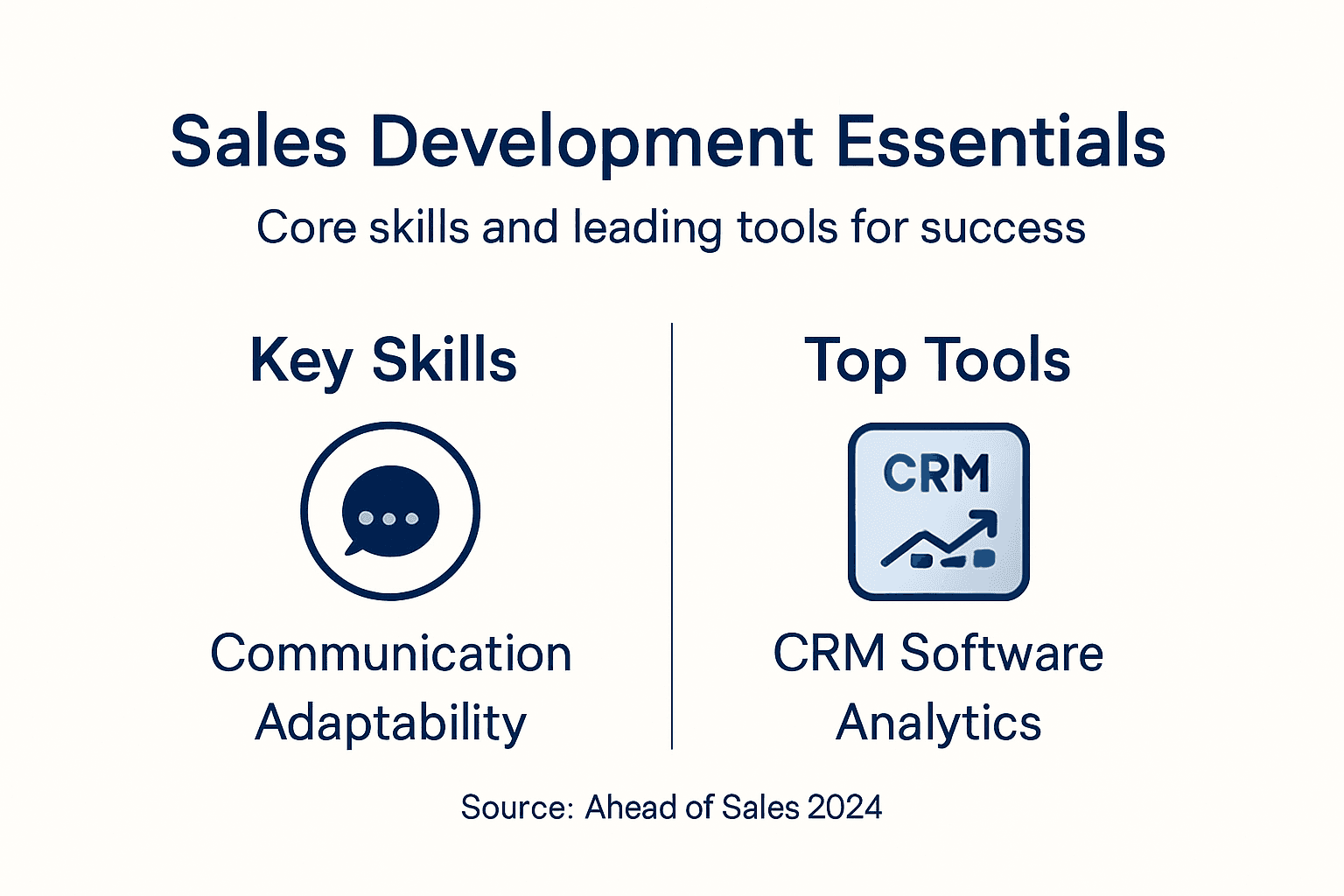
Successful sales development demands a sophisticated blend of interpersonal skills and technological proficiency. Modern sales professionals leverage comprehensive technological tools to enhance their performance and drive consistent business growth.
The critical skills required for contemporary sales success include:
- Emotional Intelligence: Understanding and managing customer interactions
- Active Listening: Comprehending nuanced customer needs and motivations
- Strategic Communication: Articulating value propositions clearly and persuasively
- Data Interpretation: Analysing sales metrics and customer insights
- Adaptability: Quickly responding to changing market dynamics
Digital literacy has become a fundamental requirement in sales development. Professionals must now seamlessly integrate advanced technologies into their daily workflow, transforming traditional sales approaches through data-driven strategies and intelligent customer engagement tools.
Key technologies enabling sales success encompass:
- Customer Relationship Management (CRM) platforms
- Sales analytics and predictive intelligence software
- Communication and collaboration tools
- Social selling platforms
- Automated lead generation and qualification systems
Technological skills are no longer optional – they are essential for competitive sales performance in the modern business landscape.
Pro tip: Invest at least two hours weekly in learning new sales technologies and digital skills to remain competitive in your industry.
Risks, costs, and common mistakes to avoid
Sales development involves navigating complex challenges that can significantly impact organisational performance. Ineffective sales methodologies create substantial business risks by undermining strategic growth and revenue potential.
The most critical risks and potential pitfalls in sales development include:
- Resource Misallocation: Investing in unproductive sales strategies
- Market Misalignment: Failing to adapt to changing customer needs
- Inconsistent Performance: Lacking standardised sales approaches
- Talent Retention: High turnover due to ineffective training and support
- Technology Gaps: Inadequate digital tools and infrastructure
Financial implications of poor sales development can be substantial, potentially resulting in significant revenue losses and decreased market competitiveness. Organisations must proactively identify and mitigate these risks through strategic planning and continuous improvement.
Below is a summary of risks, costs, and the organisational consequences of common sales development mistakes:
| Risk or Mistake | Cost Implication | Organisational Consequence |
|---|---|---|
| Resource Misallocation | Lost investments | Reduced profitability |
| Market Misalignment | Missed opportunities | Decreased market share |
| Inconsistent Performance | Poor sales outcomes | Unpredictable revenue streams |
| Talent Retention Challenges | High turnover expenses | Loss of expertise |
| Technology Gaps | Inefficiency costs | Lagging in competitiveness |
Common mistakes that organisations frequently encounter include:
- Neglecting comprehensive lead qualification processes
- Overlooking ongoing sales team training and development
- Implementing rigid, non-adaptive sales methodologies
- Undervaluing data-driven performance analysis
- Failing to integrate advanced technological solutions
Successful sales development requires a dynamic, adaptable approach that anticipates and responds to evolving market conditions.
Pro tip: Conduct quarterly comprehensive reviews of your sales development strategy to identify potential risks and immediately implement corrective measures.
Unlock Consistent Sales Growth with Expert Sales Development Support
The article highlights the challenges UK firms face in creating a dynamic and adaptable sales development strategy that drives sustainable growth. If your business is grappling with resource misallocation, market misalignment or the pressure to develop a skilled, tech-savvy sales team then it is clear that having a bespoke coaching and consultancy partner is vital. Key pain points such as improving lead qualification, fostering meaningful customer relationships and embedding data-driven performance analysis can be transformed with tailored interventions. By integrating strategic training with proven sales methodologies your organisation can overcome these hurdles and consistently hit ambitious targets.

Take the next step to accelerate your sales results today by exploring our Sales Strategy Archives – Ahead of Sales for practical insights and expert guidance. Our revolutionary sales training packages at Ahead of Sales combine bespoke 1:1 coaching alongside traditional consultancy to help businesses generate at least 50% sales growth annually. Whether you are a mid-sized firm or a solo service business, our tailored sales acceleration solutions ensure your team adapts quickly and wins consistently. Discover how to align your sales development approach with changing market needs now by visiting our Sales Playbook Archives – Ahead of Sales and making the transformation your business deserves.
Frequently Asked Questions
What is sales development?
Sales development is a strategic approach focused on identifying, engaging, and qualifying potential business opportunities within an organisation’s sales ecosystem. It involves adapting selling techniques to meet diverse customer needs.
What types of sales development representatives are there?
There are several types of sales development representatives, including inside sales representatives, outside sales representatives, technical sales representatives, and telemarketing specialists, each serving unique roles within the sales process.
What are the core stages of the sales development process?
The core stages of the sales development process include prospecting, lead qualification, needs analysis, solution mapping, and proposal development, all aimed at creating meaningful customer interactions and revenue generation.
What essential skills are required for successful sales development?
Key skills required for successful sales development include emotional intelligence, active listening, strategic communication, data interpretation, and adaptability, alongside proficiency in various technological tools to enhance performance.