
The pressure to sustain predictable revenue and engagement often leaves UK sales leaders searching for smarter methods. Many believe a sales cadence is just a simple schedule, yet in reality it is a nuanced framework that shapes how your team connects and progresses deals. This article clarifies sales cadence misconceptions and outlines advanced strategies to help you create more adaptive, data-driven communication rhythms that support scalable growth.
Table of Contents
- Sales Cadence Defined And Misconceptions
- Types Of Sales Cadence And Their Uses
- Step-By-Step Process Of Building A Cadence
- Real-World Applications In Uk Sales Teams
- Common Pitfalls And How To Fix Them
Key Takeaways
| Point | Details |
|---|---|
| Understanding Sales Cadence | A sales cadence is a dynamic, personalised sequence of interactions designed to engage potential customers throughout their purchasing journey. |
| Types of Sales Cadence | There are four main types: Solution Selling, Transactional Selling, Consultative Selling, and Inbound Selling, each suited to different sales strategies and customer needs. |
| Building a Cadence | An effective cadence requires a methodical approach including customer discovery, channel planning, and performance tracking to ensure it adapts over time. |
| Common Pitfalls | Challenges such as poor communication alignment and inadequate technology integration can undermine sales cadence effectiveness, requiring ongoing adaptation and training. |
Sales Cadence Defined and Misconceptions
A sales cadence represents the systematic sequence of touchpoints and interactions a sales representative uses to engage potential customers and move them through the purchasing journey. Unlike simplistic interpretations, this strategic approach involves carefully choreographed communication rhythms designed to build relationship momentum.
In business contexts, cadence signifies operational tempo that supports consistent engagement. However, numerous misconceptions exist about what truly constitutes an effective sales cadence:
- Not merely a rigid communication schedule
- More than just a predetermined number of contact attempts
- Requires nuanced understanding of prospect preferences
- Demands adaptive communication strategies
Misconceptions often arise from viewing sales cadence as a mechanical process rather than a dynamic, personalised approach. Sales professionals mistakenly believe that uniform interaction patterns work universally, when in reality, successful cadences are tailored to specific:
- Prospect demographics
- Industry vertical
- Individual buying signals
- Communication channel preferences
By understanding cadence as a fluid, responsive strategy rather than a static template, sales teams can dramatically improve engagement rates and conversion potential. The goal is creating a rhythmic yet flexible communication framework that respects potential customer journeys.

Pro tip: Map your ideal customer’s typical communication preferences and decision-making timelines before designing your sales cadence strategy.
Types of Sales Cadence and Their Uses
Sales cadence represents a strategic approach to customer engagement that varies significantly across different sales methodologies. Systematic sales process engineering reveals that effective cadences are not one-size-fits-all but carefully designed frameworks tailored to specific business contexts.
Based on comprehensive research, four primary sales cadence types emerge, each serving distinct strategic objectives:
-
Solution Selling Cadence
- Focuses on complex, high-value transactions
- Requires deep customer problem understanding
- Longer interaction cycles with multiple touchpoints
- Emphasises consultative relationship building
-
Transactional Selling Cadence
- Optimised for rapid, straightforward sales
- Minimal interaction required
- Short, precise communication sequences
- Ideal for standardised products or services
-
Consultative Selling Cadence
- Prioritises relationship and trust development
- Multiple discovery and exploration stages
- Highly personalised communication approach
- Longer sales cycles with detailed needs analysis
-
Inbound Selling Cadence
- Responds to customer-initiated interest
- Quick, targeted follow-up strategies
- Uses digital engagement channels
- Focuses on converting pre-qualified leads
Understanding these sales cadence variations enables sales teams to align their communication strategies with specific customer interaction requirements. The key is matching the cadence type to the customer’s buying journey, industry context, and individual preferences.
Here’s a comparison of common sales cadence types, their primary focus, and optimal use cases:
| Cadence Type | Main Focus | Best Used For |
|---|---|---|
| Solution Selling | Deep problem analysis | High-value, complex deals |
| Transactional Selling | Speed and simplicity | Quick sales of standard products |
| Consultative Selling | Trust and personalised advice | Extended negotiations, discovery |
| Inbound Selling | Reactive, prompt engagement | Responding to self-qualified leads |
Successful implementation demands continuous adaptation and refinement. Sales professionals must remain flexible, using data-driven insights to adjust their approach dynamically and maintain engagement momentum.
Pro tip: Regularly analyse your sales team’s performance metrics to identify which cadence type generates the most consistent and high-value conversions.
Step-by-Step Process of Building a Cadence
Building an effective sales cadence requires a methodical approach that transforms random interactions into strategic engagement. Sales process engineering provides a structured framework for creating a repeatable, scalable communication strategy that consistently drives results.
To construct a robust sales cadence, sales professionals must follow a comprehensive, data-driven approach:
-
Customer Discovery and Segmentation
- Analyse existing customer data
- Create detailed buyer personas
- Identify high-value prospect characteristics
- Map potential communication preferences
-
Channel and Frequency Planning
- Select appropriate communication channels
- Determine optimal interaction frequencies
- Balance between persistence and intrusion
- Consider industry-specific communication norms
-
Content and Messaging Strategy
- Develop personalised communication scripts
- Craft value-proposition-focused messaging
- Create multi-touch communication sequences
- Align content with buyer’s journey stage
-
Performance Tracking and Iteration
- Establish key performance indicators
- Implement robust tracking mechanisms
- Continuously analyse engagement metrics
- Regularly refine cadence based on data insights
Optimizing sales processes demands continuous refinement and a willingness to adapt. Successful cadence building is not a one-time event but an ongoing process of strategic adjustment and performance enhancement.
Each step requires careful consideration and precise execution. Sales teams must remain flexible, using data-driven insights to dynamically adjust their approach and maintain meaningful customer engagement.
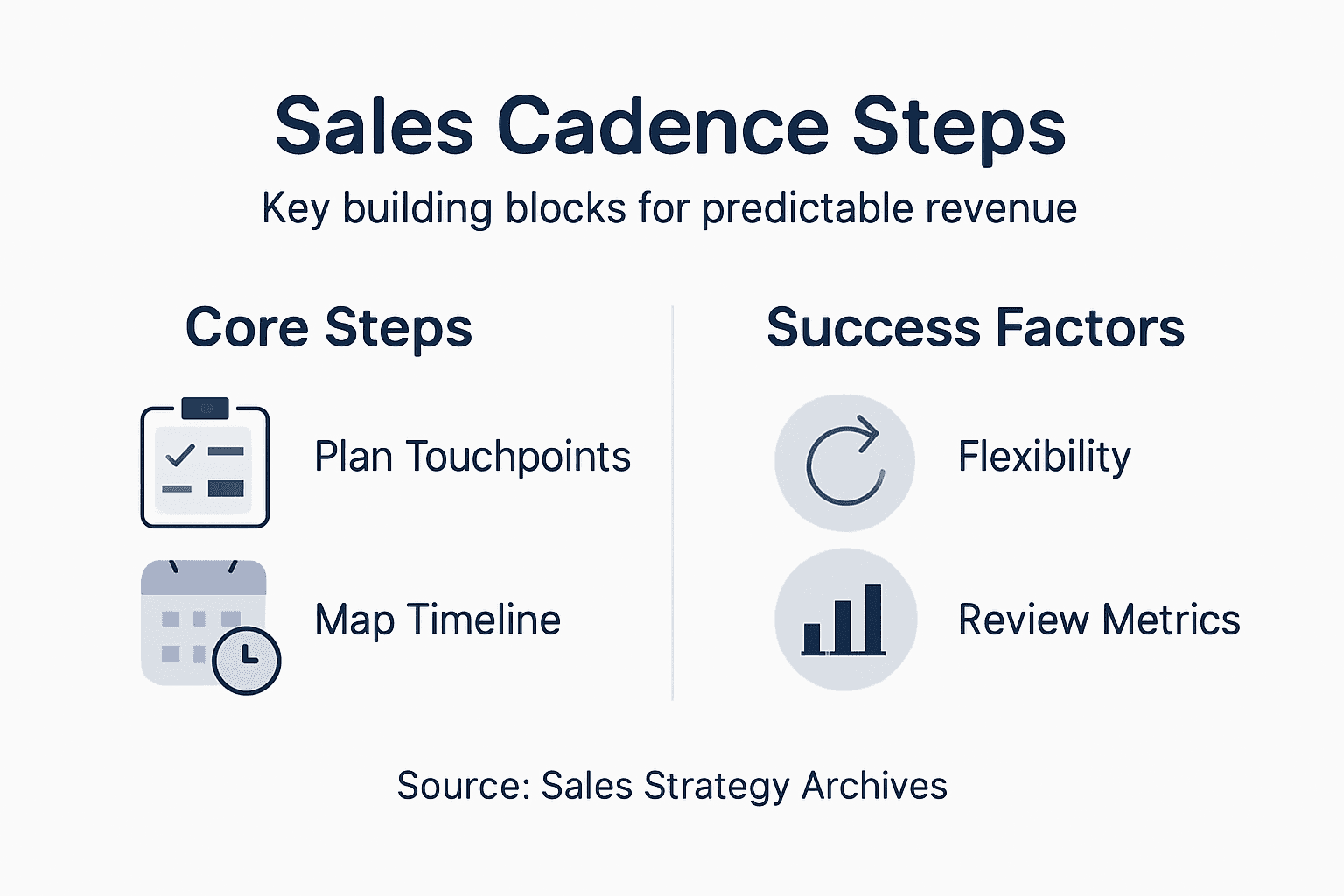
Pro tip: Conduct monthly performance reviews to identify and eliminate communication touchpoints with consistently low engagement rates.
This table outlines key factors that contribute to an effective, agile sales cadence:
| Success Factor | Why It Matters |
|---|---|
| Data-driven adaptation | Enables ongoing process improvement |
| Personalised messaging | Increases rapport and response rates |
| Channel optimisation | Maximises prospect engagement |
| Consistent performance review | Identifies and removes weak points |
Real-World Applications in UK Sales Teams
UK sales teams are increasingly transforming their approach to customer engagement through strategic sales cadence implementation. Successful sales strategies now leverage advanced technologies and data-driven methodologies to create more personalised, responsive communication frameworks.
Practical applications of sophisticated sales cadence strategies across UK industries include:
-
Technology Sector
- Utilise AI-driven interaction tracking
- Personalise communication sequences
- Automate routine follow-up processes
- Reduce manual administrative tasks
-
Financial Services
- Implement multi-channel engagement strategies
- Create segmented communication approaches
- Track customer interaction preferences
- Develop predictive engagement models
-
Manufacturing and B2B Sales
- Design industry-specific communication rhythms
- Match cadence to complex decision-making cycles
- Use data analytics for strategic outreach
- Align communication with buyer’s journey stages
-
Professional Services
- Develop relationship-driven communication strategies
- Balance frequency and depth of interactions
- Personalise communication based on client needs
- Use technology to enhance human connection
Sales team management increasingly emphasises technology integration and human expertise. The most successful UK sales teams are those that can seamlessly blend technological capabilities with nuanced human interaction, creating a dynamic and responsive sales ecosystem.
Effective cadence implementation requires continuous learning, adaptation, and a willingness to experiment with emerging technologies and communication strategies. Sales professionals must remain agile, using data insights to refine their approach continuously.
Pro tip: Conduct quarterly technology and communication strategy audits to ensure your sales cadence remains cutting-edge and responsive to changing market dynamics.
Common Pitfalls and How to Fix Them
Sales cadence strategies are intricate systems vulnerable to numerous operational challenges that can derail revenue generation. Strategic business management reveals that most pitfalls stem from systemic issues rather than isolated mistakes.
The most critical sales cadence pitfalls include:
-
Poor Communication Alignment
- Inconsistent messaging across team members
- Lack of standardised communication protocols
- Misaligned understanding of customer journey
- Fragmented communication strategies
-
Technological Integration Failures
- Inadequate CRM system configuration
- Manual data entry causing information gaps
- Inefficient tracking of customer interactions
- Limited use of automation capabilities
-
Performance Tracking Weaknesses
- Undefined key performance indicators
- Inconsistent measurement of engagement metrics
- Lack of data-driven decision-making processes
- Limited feedback and adaptation mechanisms
-
Human Resource Challenges
- Insufficient sales team training
- Poor understanding of cadence principles
- Resistance to technological adoption
- Misaligned incentive structures
Sales team management emphasises that resolving these pitfalls requires a holistic approach combining technological sophistication with continuous human skill development. Successful organisations create adaptive frameworks that balance systematic processes with individual sales professional creativity.
Addressing these challenges demands a proactive, strategic approach that prioritises ongoing learning, technological integration, and performance optimisation. Sales teams must remain agile, constantly reassessing and refining their communication strategies.
Pro tip: Implement quarterly cross-functional workshops to identify and address emerging sales cadence challenges before they become systemic problems.
Unlock Predictable Revenue Growth with a Bespoke Sales Cadence
Struggling to create a sales cadence that truly drives predictable revenue growth and aligns perfectly with your customers’ unique journeys? This article highlights how many sales teams face challenges with poor communication alignment, technological gaps, and ineffective performance tracking — all critical pain points that hold back consistent sales success. If your business aims to personalise engagement, adapt dynamically to buyer preferences, and optimise every touchpoint, mastering your sales cadence is essential.
At Ahead of Sales, we combine bespoke 1:1 coaching with proven training methods designed specifically for businesses ready to accelerate growth. Our expert programmes focus on converting the complex strategies you read about into actionable frameworks that guarantee your sales team hits targets every quarter. Whether you are refining a solution selling approach or integrating consultative cadence techniques, our tailored packages ensure you build a seamless rhythm for reliable pipeline development.
Explore deeper sales insights in our Sales Strategy Archives – Ahead of Sales and strengthen your team’s execution with resources from our Sales Playbook Archives – Ahead of Sales.
Take control of your revenue engine today by partnering with Ahead of Sales. Visit us at https://aheadofsales.co.uk and discover how our innovative coaching and consultancy can transform your sales cadence into a powerful growth driver. Don’t let unpredictable outcomes hold your business back. Act now to start hitting your sales targets consistently every quarter.
Frequently Asked Questions
What is a sales cadence?
A sales cadence is the systematic sequence of touchpoints and interactions that a sales representative uses to engage potential customers, designed to move them through the purchasing journey.
How do I tailor my sales cadence to different types of prospects?
To tailor your sales cadence, consider factors such as prospect demographics, industry vertical, individual buying signals, and communication channel preferences to create a personalised engagement strategy.
What are the different types of sales cadences?
The four primary types of sales cadences are Solution Selling, Transactional Selling, Consultative Selling, and Inbound Selling. Each serves distinct objectives based on the complexity and nature of the sales process.
How can I measure the effectiveness of my sales cadence?
You can measure the effectiveness of your sales cadence through key performance indicators (KPIs) by tracking engagement metrics, conversion rates, and continuous analysis of customer interactions to refine your approach.